The Sun
The Sun is a yellow dwarf star (G2V), about 4.6 billion years old, and the dominant gravitational force in the Solar System. It has a diameter of roughly 1.4 million kilometers and contains around 99.8% of the Solar System’s mass. Nuclear fusion in its core converts hydrogen into helium, producing energy that warms the planets. Above the core lie the radiative and convective zones, followed by the visible photosphere (~5,500 °C), the chromosphere, and the much hotter corona (~2 million °C).
Source: science.nasa.gov
APODs including "The Sun"
Announcing Comet C/2003 K4 (LINEAR)
30/08/2004
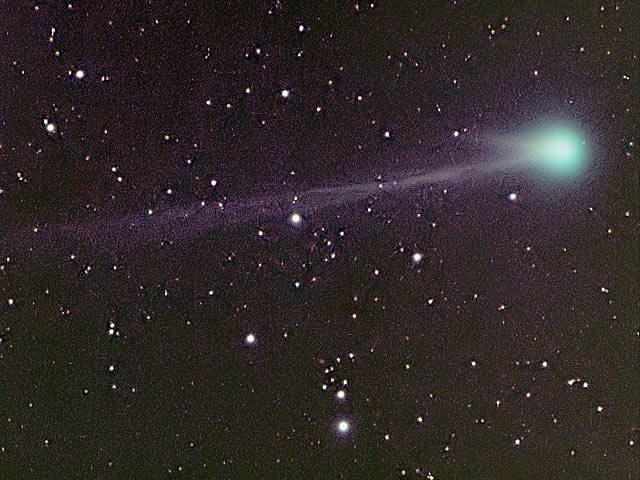
A comet discovered last year has brightened unexpectedly and now may become visible to the unaided eye within the next month. Designated Comet C/2003 K4 (LINEAR), the comet was discovered in 2003 May by project LINEAR. Many reports already place the comet as brighter than magnitude 7, meaning that it can now be seen with binoculars. Reports also indicate the comet already has a visible tail nearly the length of a full Moon. Since predicting the future brightness of comets is a very tricky business, there remains the possibility that K4 might never become very bright. Current predictions, however, estimate the comet may approach fifth magnitude in October. K4 passes closest to the Sun on October 12 and then closest to the Earth on December 23. Comet K4 was photographed above from Van Buren, Arkansas, USA on August 17.