The Sun
The Sun is a yellow dwarf star (G2V), about 4.6 billion years old, and the dominant gravitational force in the Solar System. It has a diameter of roughly 1.4 million kilometers and contains around 99.8% of the Solar System’s mass. Nuclear fusion in its core converts hydrogen into helium, producing energy that warms the planets. Above the core lie the radiative and convective zones, followed by the visible photosphere (~5,500 °C), the chromosphere, and the much hotter corona (~2 million °C).
Source: science.nasa.gov
APODs including "The Sun"
X-Rays from the Galactic Core
06/11/2004
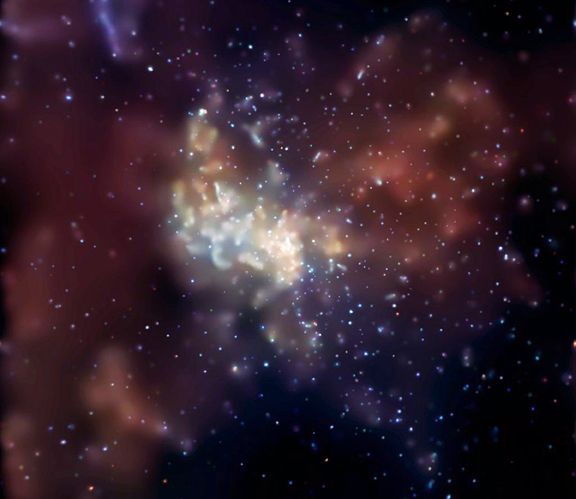
Using the orbiting Chandra X-ray Observatory, astronomers have taken this long look at the core of our Milky Way galaxy, some 26,000 light-years away. The spectacular false-color view spans about 130 light-years. It reveals an energetic region rich in x-ray sources and high-lighted by the central source, Sagittarius A*, known to be a supermassive black hole with 3 million times the mass of the Sun. Given its tremendous mass, Sagittarius A* is amazingly faint in x-rays in comparison to central black holes observed in distant galaxies, even during its frequent x-ray flares. This suggests that this supermassive black hole has been starved by a lack of infalling material. In fact, the sharp Chandra image shows clouds of multi-million degree gas dozens of light-years across flanking (upper right and lower left) the central region -- evidence that violent events have cleared much material from the vicinity of the black hole.