The Sun
The Sun is a yellow dwarf star (G2V), about 4.6 billion years old, and the dominant gravitational force in the Solar System. It has a diameter of roughly 1.4 million kilometers and contains around 99.8% of the Solar System’s mass. Nuclear fusion in its core converts hydrogen into helium, producing energy that warms the planets. Above the core lie the radiative and convective zones, followed by the visible photosphere (~5,500 °C), the chromosphere, and the much hotter corona (~2 million °C).
Source: science.nasa.gov
APODs including "The Sun"
The Galactic Center in Infrared
07/11/2004
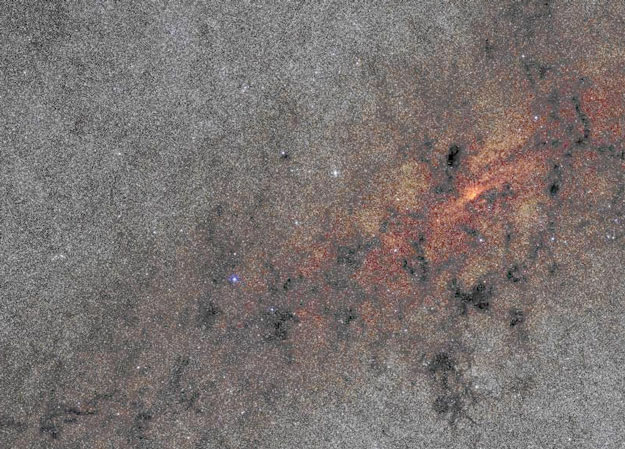
The center of our Galaxy is a busy place. In visible light, much of the Galactic Center is obscured by opaque dust. In infrared light, however, dust glows more and obscures less, allowing nearly one million stars to be recorded in the above photograph. The Galactic Center itself appears on the right and is located about 30,000 light years away towards the constellation of Sagittarius. The Galactic Plane of our Milky Way Galaxy, the plane in which the Sun orbits, is identifiable by the dark diagonal dust lane. The absorbing dust grains are created in the atmospheres of cool red-giant stars and grow in molecular clouds. The region directly surrounding the Galactic Center glows brightly in radio and high-energy radiation, and is thought to house a large black hole.