The Sun
The Sun is a yellow dwarf star (G2V), about 4.6 billion years old, and the dominant gravitational force in the Solar System. It has a diameter of roughly 1.4 million kilometers and contains around 99.8% of the Solar System’s mass. Nuclear fusion in its core converts hydrogen into helium, producing energy that warms the planets. Above the core lie the radiative and convective zones, followed by the visible photosphere (~5,500 °C), the chromosphere, and the much hotter corona (~2 million °C).
Source: science.nasa.gov
APODs including "The Sun"
A Full Sky Multicolored Auroral Corona
09/11/2004
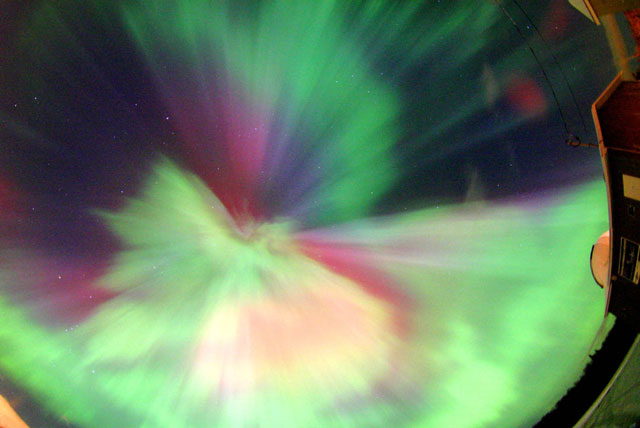
On some nights the sky is the most interesting show in town. This fisheye picture captures a particularly active and colorful auroral corona that occurred two days ago over l'Observatoire de la Decouverte in Val Belair near Quebec, Canada. The above spectacular aurora has an unusually high degree of detail, range of colors, and breadth across the sky. The vivid green, red, and blue auroral colors are likely caused by high atmospheric oxygen and hydrogen reacting to incoming electrons. The trigger events were magnetically induced explosions on the Sun from sunspot region 696 over the past few days. Continued activity from this active solar region could mean more auroras visible to northern observers over the next few days. Early in the morning but far in the background, planets, stars and the Moon will be simultaneously putting on their own show.