The Sun
The Sun is a yellow dwarf star (G2V), about 4.6 billion years old, and the dominant gravitational force in the Solar System. It has a diameter of roughly 1.4 million kilometers and contains around 99.8% of the Solar System’s mass. Nuclear fusion in its core converts hydrogen into helium, producing energy that warms the planets. Above the core lie the radiative and convective zones, followed by the visible photosphere (~5,500 °C), the chromosphere, and the much hotter corona (~2 million °C).
Source: science.nasa.gov
APODs including "The Sun"
Mercury Over Leeds
07/03/2005
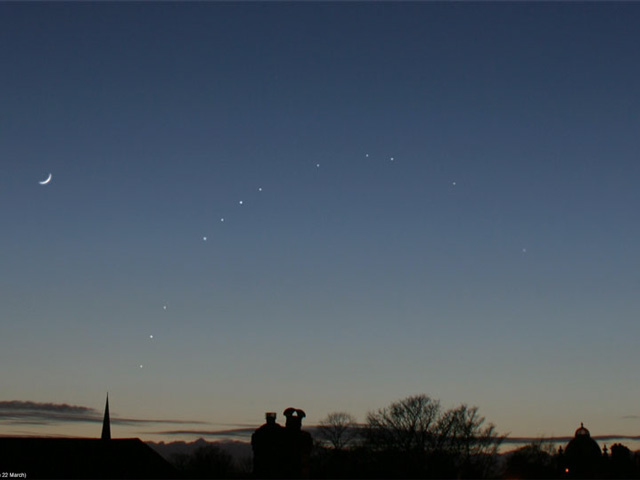
Have you ever seen the planet Mercury? This week might be a good time. Because Mercury orbits so close to the Sun, it never wanders far from the Sun in Earth's sky. If trailing the Sun, Mercury will be visible low on the horizon for only a short while after sunset. If leading the Sun, Mercury will be visible only shortly before sunrise. So at certain times of the year an informed skygazer with a little determination can usually pick Mercury out from a site with an clear horizon. Above, a lot of determination has been combined with a little digital trickery to show Mercury's successive positions during March of 2004. Each picture was taken from the same location in Leeds, England exactly 33 minutes after sunset. Over the next two weeks, Mercury will again be well placed for viewing above the western horizon at sunset, but by the third week in March it will have faded and dropped into the twilight.