The Sun
The Sun is a yellow dwarf star (G2V), about 4.6 billion years old, and the dominant gravitational force in the Solar System. It has a diameter of roughly 1.4 million kilometers and contains around 99.8% of the Solar System’s mass. Nuclear fusion in its core converts hydrogen into helium, producing energy that warms the planets. Above the core lie the radiative and convective zones, followed by the visible photosphere (~5,500 °C), the chromosphere, and the much hotter corona (~2 million °C).
Source: science.nasa.gov
APODs including "The Sun"
ULXs in M74
30/03/2005
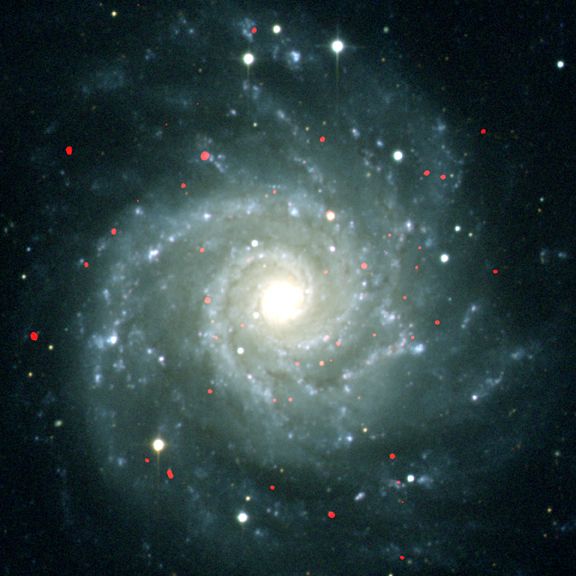
In visual appearance, M74 is a nearly perfect face-on spiral galaxy, about 30 million light-years away toward the constellation Pisces. The red blotches seen in this composite view are ultraluminous x-ray sources (ULXs) mapped by the Chandra X-ray Observatory. The ULXs are so called because they actually do radiate 10 to 1,000 times more x-ray power than "ordinary" x-ray binary stars, which harbor a neutron star or stellar mass black hole. In fact, watching these ULXs change their x-ray brightness over periods of 2 hours or so, astronomers conclude that ULXs could well be intermediate mass black holes -- black holes with masses 10,000 times or so greater than the Sun, but still much less than the million solar mass black holes which lurk in the centers of large spiral galaxies. How did these intermediate mass black holes get there? One intriguing suggestion is that they are left over from the cores of much smaller galaxies that are merging with spiral galaxy M74.