The Sun
The Sun is a yellow dwarf star (G2V), about 4.6 billion years old, and the dominant gravitational force in the Solar System. It has a diameter of roughly 1.4 million kilometers and contains around 99.8% of the Solar System’s mass. Nuclear fusion in its core converts hydrogen into helium, producing energy that warms the planets. Above the core lie the radiative and convective zones, followed by the visible photosphere (~5,500 °C), the chromosphere, and the much hotter corona (~2 million °C).
Source: science.nasa.gov
APODs including "The Sun"
April's Moon and the Pleiades
14/04/2005
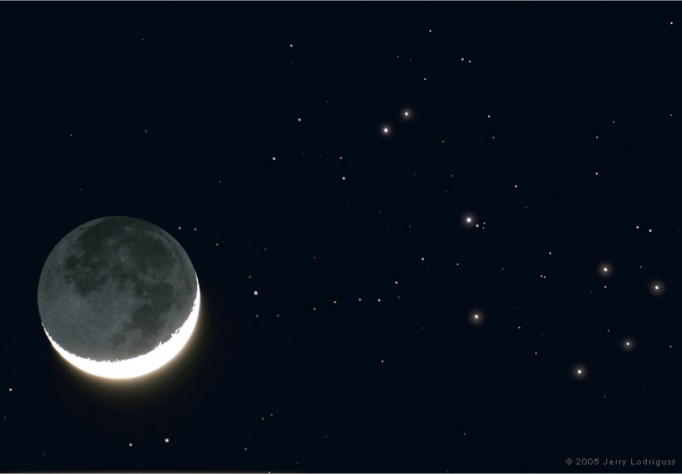
After parting with the Sun late last week, April's moon graced the early evening sky. Its slender, three-day-old crescent shares this lovely telescopic skyview with the nearby Pleiades star cluster. Here, the Moon's sunlit crescent is overexposed while the lunar terminator, or boundary between lunar night and day, is jagged with craters and mountains. Lunar surface features can also be seen in the dim lunar night illuminated by earthshine - light from sunlit planet Earth. The sister stars of the Pleiades are grouped at the right, but their alluring blue reflection nebulae, usually highlighted in telescopic images of the cluster, are washed-out in the much brighter moonlight.