The Sun
The Sun is a yellow dwarf star (G2V), about 4.6 billion years old, and the dominant gravitational force in the Solar System. It has a diameter of roughly 1.4 million kilometers and contains around 99.8% of the Solar System’s mass. Nuclear fusion in its core converts hydrogen into helium, producing energy that warms the planets. Above the core lie the radiative and convective zones, followed by the visible photosphere (~5,500 °C), the chromosphere, and the much hotter corona (~2 million °C).
Source: science.nasa.gov
APODs including "The Sun"
Mira: The Wonderful Star
05/05/2005
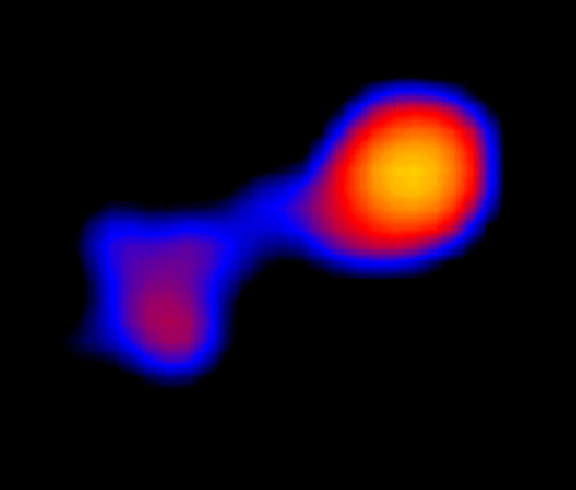
To seventeenth century astronomers, Omicron Ceti or Mira was known as a wonderful star - a star whose brightness could change dramatically in the course of about 11 months. Modern astronomers now recognize an entire class of long period Mira-type variables as cool, pulsating, red giant stars, 700 or so times the diameter of the Sun. Only 420 light-years away, red giant Mira (Mira A, right) itself co-orbits with a companion star, a small white dwarf (Mira B). Mira B is surrounded by a disk of material drawn from the pulsating giant and in such a double star system, the white dwarf star's hot accretion disk is expected to produce some x-rays. But this sharp, false-color image from the Chandra Observatory also captures the cool giant star strongly flaring at x-ray energies, clearly separated from the x-ray emission of its companion's accretion disk. Placing your cursor over the Chandra x-ray image of Mira will reveal an artist's vision of this still wonderful interacting binary star system.