The Sun
The Sun is a yellow dwarf star (G2V), about 4.6 billion years old, and the dominant gravitational force in the Solar System. It has a diameter of roughly 1.4 million kilometers and contains around 99.8% of the Solar System’s mass. Nuclear fusion in its core converts hydrogen into helium, producing energy that warms the planets. Above the core lie the radiative and convective zones, followed by the visible photosphere (~5,500 °C), the chromosphere, and the much hotter corona (~2 million °C).
Source: science.nasa.gov
APODs including "The Sun"
Hybrid Solar Eclipse
06/05/2005
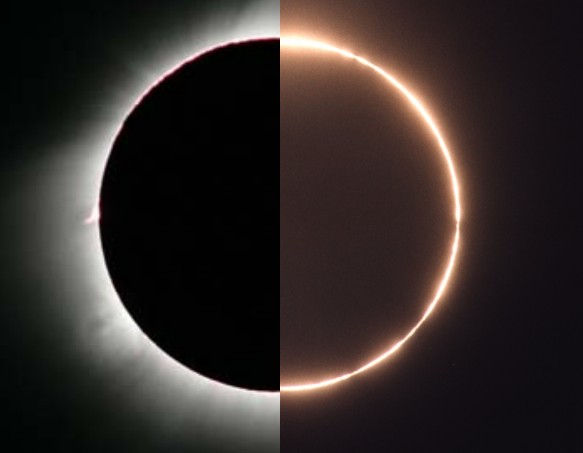
April's spectacular geocentric celestial event was a rare hybrid eclipse of the Sun - a total or an annular eclipse could be seen depending on the observer's location. For Fred Espenak, aboard a gently swaying ship within the middle of the Moon's shadow track about 2,200 kilometers west of the Galapagos, the eclipse was total, the lunar silhouette exactly covering the bright solar disk for a few brief moments. His camera captured a picture of totality revealing the extensive solar corona and prominences rising above the Sun's edge. But for Stephan Heinsius, near the end of the shadow track at Penonome Airfield, Panama, the Moon's apparent size had shrunk enough to create an annular eclipse, showing a complete annulus of the Sun's bright disk as a dramatic ring of fire. Pictures from the two locations are compared above. How rare is such a hybrid eclipse? Calculations show that during the 21st century just 3.1% (7 out of 224) of solar eclipses are hybrid while hybrids comprise about 5% of all solar eclipses over the period 2000 BC to AD 4000.