The Sun
The Sun is a yellow dwarf star (G2V), about 4.6 billion years old, and the dominant gravitational force in the Solar System. It has a diameter of roughly 1.4 million kilometers and contains around 99.8% of the Solar System’s mass. Nuclear fusion in its core converts hydrogen into helium, producing energy that warms the planets. Above the core lie the radiative and convective zones, followed by the visible photosphere (~5,500 °C), the chromosphere, and the much hotter corona (~2 million °C).
Source: science.nasa.gov
APODs including "The Sun"
Stars, Galaxies, and Comet Tempel 1
12/05/2005
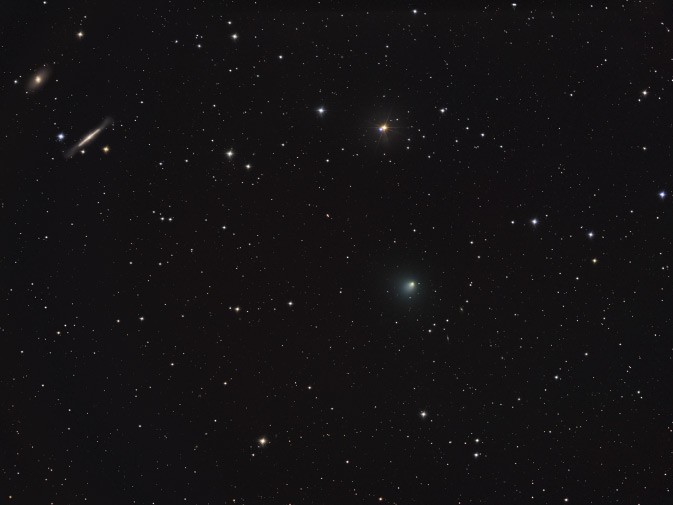
Faint comet Tempel 1 sports a fuzzy blue-tinted tail, just right of center in this lovely field of stars. Recorded on May 3rd slowly sweeping through the constellation Virgo, periodic comet Tempel 1 orbits the Sun once every 5.5 years. Also caught in the skyview are two galaxies at the upper left - NGC 4762 and NGC 4754 - both members of the large Virgo Cluster of galaxies. Classified as a lenticular galaxy, NGC 4762 presents an edge-on disk as a narrow gash of light while NGC 4754 is a football-shaped elliptical galaxy. Similar in apparent size, the galaxies and comet make for an intriguing visual comparison, but Tempel 1 is only about 3 light-minutes from planet Earth. The two Virgo cluster galaxies are 50 million light-years away. NASA's Deep Impact spacecraft is scheduled to encounter Tempel 1 on July 4th, launching a probe to impact the comet's nucleus.