The Sun
The Sun is a yellow dwarf star (G2V), about 4.6 billion years old, and the dominant gravitational force in the Solar System. It has a diameter of roughly 1.4 million kilometers and contains around 99.8% of the Solar System’s mass. Nuclear fusion in its core converts hydrogen into helium, producing energy that warms the planets. Above the core lie the radiative and convective zones, followed by the visible photosphere (~5,500 °C), the chromosphere, and the much hotter corona (~2 million °C).
Source: science.nasa.gov
APODs including "The Sun"
Aurora Iowa
20/05/2005
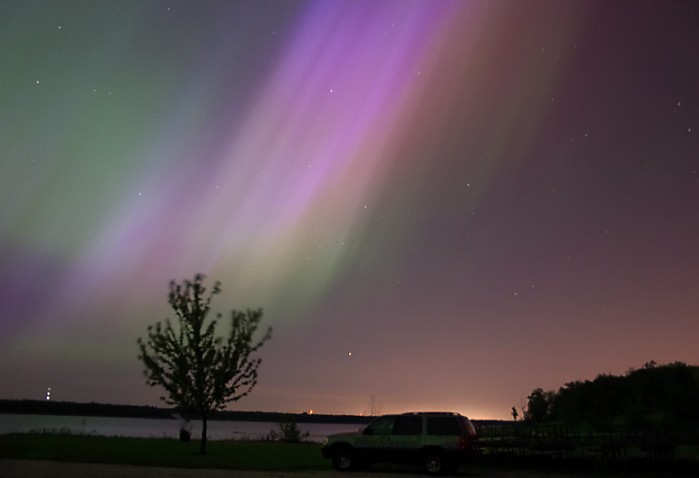
rly last Sunday morning stars were not the only lights in Iowa skies. The northern lights also shone from the heavens, extending across the midwestern USA and other locations not often graced with auroral displays. The wide-ranging auroral activity was triggered as a coronal mass ejection - an energetic cloud of particles blasted outward from the Sun a few days earlier - collided with planet Earth's magnetosphere. Alerted to conditions ripe for aurora, photographer Stan Richard recorded this aparition over Saylorville Lake, near Des Moines. Bright planet Mars in the constellation Aquarius is above the horizon near the center of the eastward-looking view. While the colorful rays seem to end just above the water, they are actually at altitudes of 100 kilometers or more.