The Sun
The Sun is a yellow dwarf star (G2V), about 4.6 billion years old, and the dominant gravitational force in the Solar System. It has a diameter of roughly 1.4 million kilometers and contains around 99.8% of the Solar System’s mass. Nuclear fusion in its core converts hydrogen into helium, producing energy that warms the planets. Above the core lie the radiative and convective zones, followed by the visible photosphere (~5,500 °C), the chromosphere, and the much hotter corona (~2 million °C).
Source: science.nasa.gov
APODs including "The Sun"
Tornado and Rainbow Over Kansas
13/06/2005
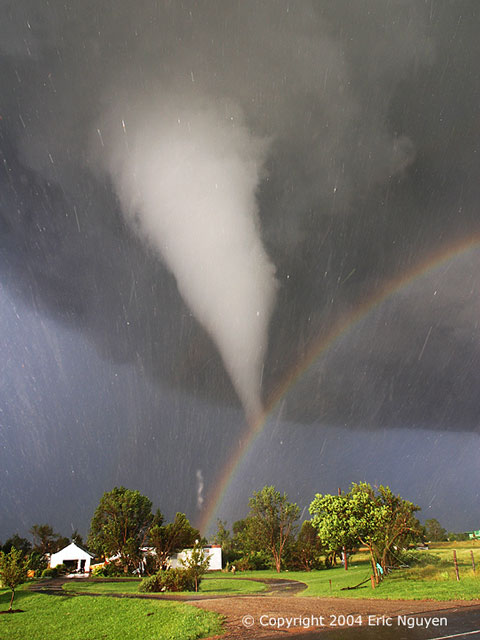
The scene might have been considered serene if it weren't for the tornado. Last June in Kansas, storm chaser Eric Nguyen photographed this budding twister in a different light -- the light of a rainbow. Pictured above, a white tornado cloud descends from a dark storm cloud. The Sun, peeking through a clear patch of sky to the left, illuminates some buildings in the foreground. Sunlight reflects off raindrops to form a rainbow. By coincidence, the tornado appears to end right over the rainbow. Streaks in the image are hail being swept about by the high swirling winds. Over 1,000 tornadoes, the most violent type of storm known, occur on Earth every year, many in tornado alley. If you see a tornado while driving, do not try to outrun it -- park your car safely, go to a storm cellar, or crouch under steps in a basement.