The Sun
The Sun is a yellow dwarf star (G2V), about 4.6 billion years old, and the dominant gravitational force in the Solar System. It has a diameter of roughly 1.4 million kilometers and contains around 99.8% of the Solar System’s mass. Nuclear fusion in its core converts hydrogen into helium, producing energy that warms the planets. Above the core lie the radiative and convective zones, followed by the visible photosphere (~5,500 °C), the chromosphere, and the much hotter corona (~2 million °C).
Source: science.nasa.gov
APODs including "The Sun"
Moonrise, Cape Sounion, Greece
23/06/2005
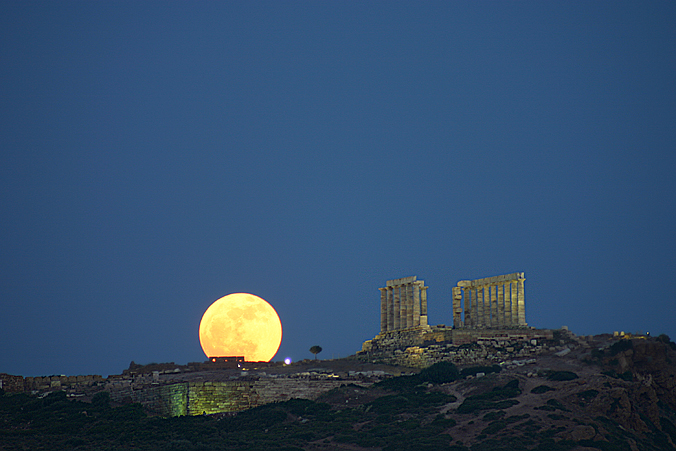
The Moon was full this month on June 22nd, only a day after the northern hemisphere's summer solstice. Since this solstice marked the northernmost point of the Sun's annual motion through planet Earth's sky, the full Moon rising near the ecliptic plane opposite the Sun was at its farthest south for the year. Only a month earlier, on May 23rd, astronomer Anthony Ayiomamitis recorded this picture of another southerly full Moon rising above Cape Sounion, Greece. The twenty-four hundred year old Temple of Poseidon lies in the foreground, also visible to sailors on the Aegean Sea. In this well-planned, single exposure, a long telephoto lens makes the Moon loom large, but even without optical aid casual skygazers often find the full Moon looking astonishingly large when seen near the horizon. That powerful visual effect is known as the Moon Illusion.