The Sun
The Sun is a yellow dwarf star (G2V), about 4.6 billion years old, and the dominant gravitational force in the Solar System. It has a diameter of roughly 1.4 million kilometers and contains around 99.8% of the Solar System’s mass. Nuclear fusion in its core converts hydrogen into helium, producing energy that warms the planets. Above the core lie the radiative and convective zones, followed by the visible photosphere (~5,500 °C), the chromosphere, and the much hotter corona (~2 million °C).
Source: science.nasa.gov
APODs including "The Sun"
Three Planets by the Sea
02/07/2005
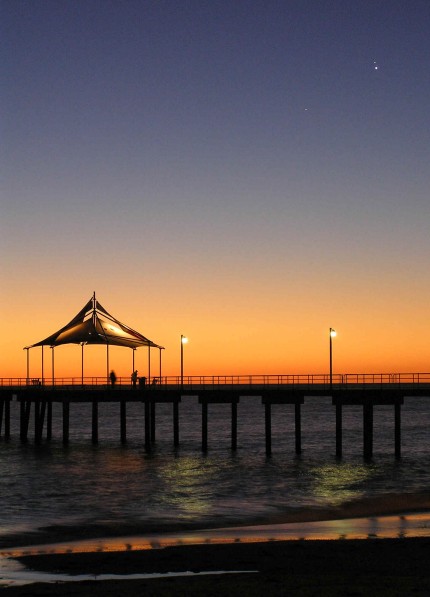
On Tuesday, June 28th, the setting Sun flooded the horizon with a beautiful warm light in this view from the beach beside the pier at Brighton in Adelaide, South Australia. The Sun also illuminated three planets gathered in the western sky, Mercury, Venus, and Saturn. From this perspective Mercury is at the highest point in the celestial triangle, brilliant Venus is just below, and Saturn stands farther to the left and below the close pair. Of course, the planets only appear close together on the sky but are actually quite far apart in space. The orbits of Mercury and Venus are both interior to Earth's orbit, while gas giant Saturn lies in the outer solar system, over nine astronomical units from the Sun. Late next week, Venus and Mercury will share western skies with the young crescent Moon.