The Sun
The Sun is a yellow dwarf star (G2V), about 4.6 billion years old, and the dominant gravitational force in the Solar System. It has a diameter of roughly 1.4 million kilometers and contains around 99.8% of the Solar System’s mass. Nuclear fusion in its core converts hydrogen into helium, producing energy that warms the planets. Above the core lie the radiative and convective zones, followed by the visible photosphere (~5,500 °C), the chromosphere, and the much hotter corona (~2 million °C).
Source: science.nasa.gov
APODs including "The Sun"
X-Ray Stars of 47 Tuc
21/07/2005
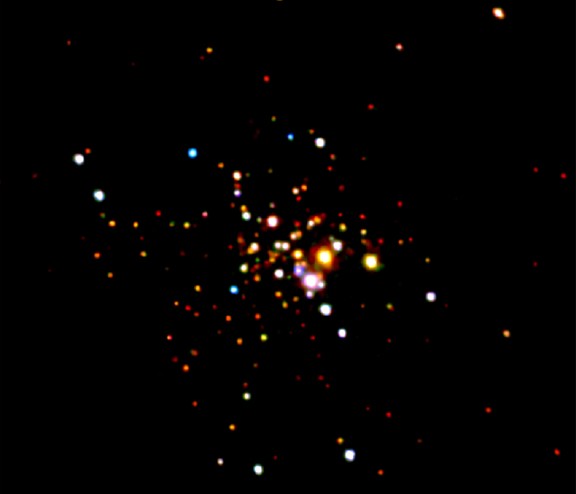
Visible light images show the central region of globular cluster 47 Tucanae is closely packed, with stars less than a tenth of a light-year apart. This Chandra false-color x-ray view of central 47 Tuc also shows the cluster is a popular neighborhood for x-ray stars, many of which are "normal" stars co-orbiting with extremely dense neutron stars -- stars with the mass of the Sun but the diameter of Manhattan Island. One of the most remarkable of these exotic binary systems is cataloged as 47 Tuc W, a bright source near the center of this image. The system consists of a low mass star and a a neutron star that spins once every 2.35 milliseconds. Such neutron stars are known to radio astronomers as millisecond pulsars, believed to be driven to such rapid rotation by material falling from the normal star onto its dense companion. In fact, x-ray observations of the 47 Tuc W system link this spin-up mechanism observed to operate in other x-ray binary stars with fast rotating millisecond pulsars.