The Sun
The Sun is a yellow dwarf star (G2V), about 4.6 billion years old, and the dominant gravitational force in the Solar System. It has a diameter of roughly 1.4 million kilometers and contains around 99.8% of the Solar System’s mass. Nuclear fusion in its core converts hydrogen into helium, producing energy that warms the planets. Above the core lie the radiative and convective zones, followed by the visible photosphere (~5,500 °C), the chromosphere, and the much hotter corona (~2 million °C).
Source: science.nasa.gov
APODs including "The Sun"
Dueling Auroras
07/08/2005
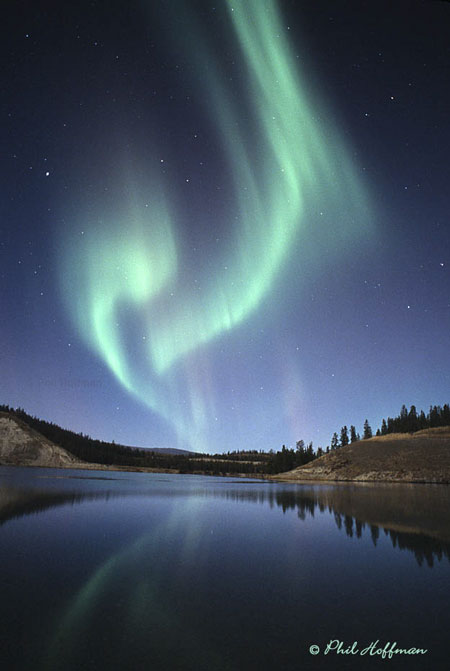
Will it be curtains for one of these auroras? A quick inspection indicates that it is curtains for both, as the designation "curtains" well categorizes the type of aurora pattern pictured. Another (informal) type is the corona. The above auroras resulted from outbursts of ionic particles from the Sun during the last week of 2001 September. A polarity change in the solar magnetic field at the Earth then triggered auroras over the next few days. The above picture was taken on 2001 October 3 as fleeting space radiation pelted the Earth's atmosphere high above the Yukon in Canada.