The Sun
The Sun is a yellow dwarf star (G2V), about 4.6 billion years old, and the dominant gravitational force in the Solar System. It has a diameter of roughly 1.4 million kilometers and contains around 99.8% of the Solar System’s mass. Nuclear fusion in its core converts hydrogen into helium, producing energy that warms the planets. Above the core lie the radiative and convective zones, followed by the visible photosphere (~5,500 °C), the chromosphere, and the much hotter corona (~2 million °C).
Source: science.nasa.gov
APODs including "The Sun"
Approaching Asteroid Itokawa
19/09/2005
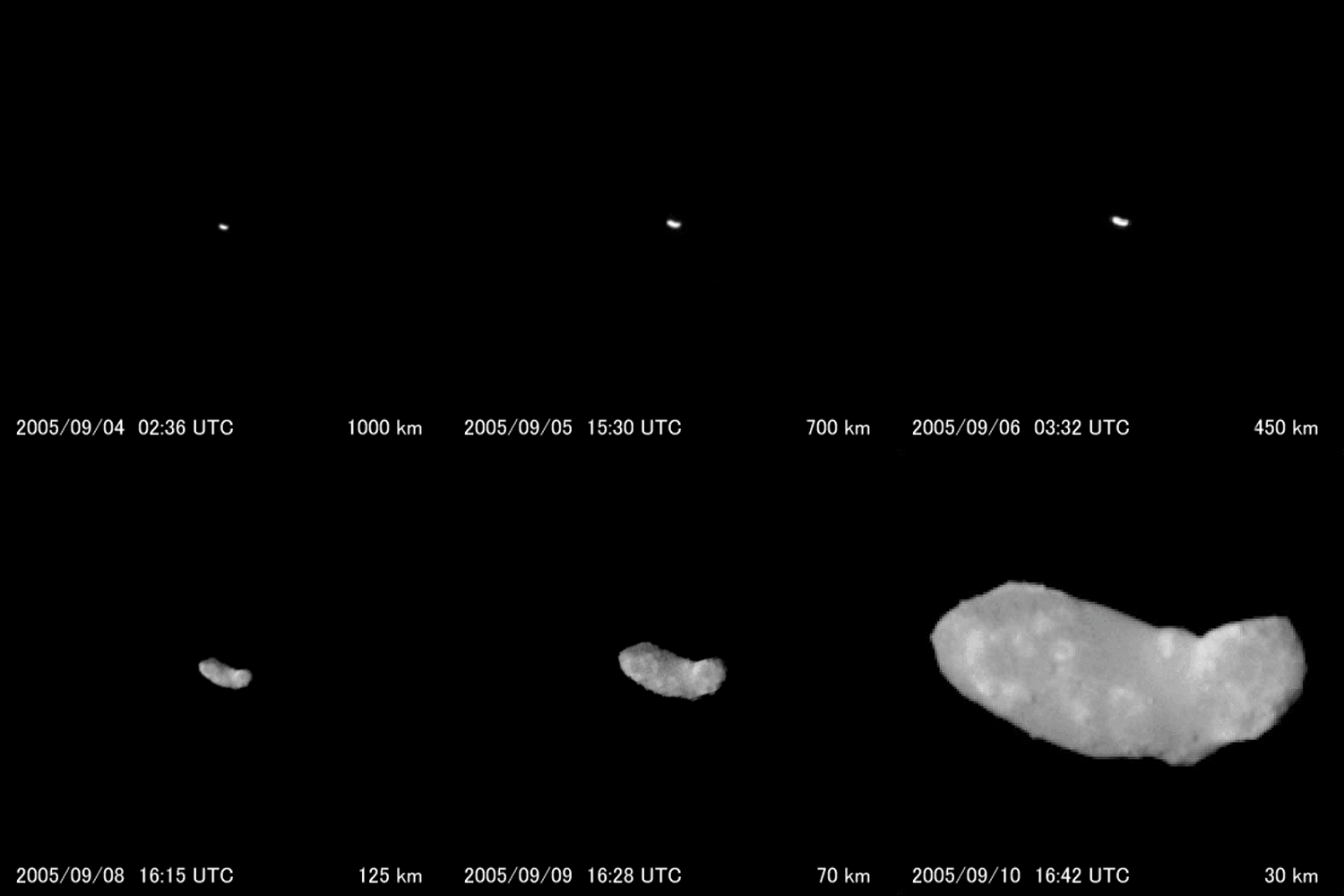
What are asteroids made of? To help find out, Japan's JAXA space agency launched the Hayabusa mission to rendezvous with asteroid Itokawa. Last week, the small robotic Hayabusa spacecraft arrived at asteroid Itokawa and stationed itself only 20 kilometers away. Although a long term goal is to find out how much ice, rock and trace elements reside on the asteroid's surface, a shorter term goal is to determine the mass of the asteroid by measuring the attraction of the drifting Hayabusa spacecraft. During the next few months, Hayabusa will also image and map asteroid Itokawa as it orbits the Sun. The above time-lapse image sequence was taken by Hayabusa upon final approach, showing the general oblong shape of the asteroid. In November, a small coffee-can sized robot dubbed MINERVA is scheduled for release and is expected to hop around the asteroid taking pictures. Also in November, Hayabusa will fire pellets into asteroid Itokawa and collect some of the debris in a return capsule. In December, Hayabusa will fire its rockets toward Earth and drop the return capsule to Earth in 2007 June.