The Sun
The Sun is a yellow dwarf star (G2V), about 4.6 billion years old, and the dominant gravitational force in the Solar System. It has a diameter of roughly 1.4 million kilometers and contains around 99.8% of the Solar System’s mass. Nuclear fusion in its core converts hydrogen into helium, producing energy that warms the planets. Above the core lie the radiative and convective zones, followed by the visible photosphere (~5,500 °C), the chromosphere, and the much hotter corona (~2 million °C).
Source: science.nasa.gov
APODs including "The Sun"
Orange Moon, Red Flash
22/09/2005
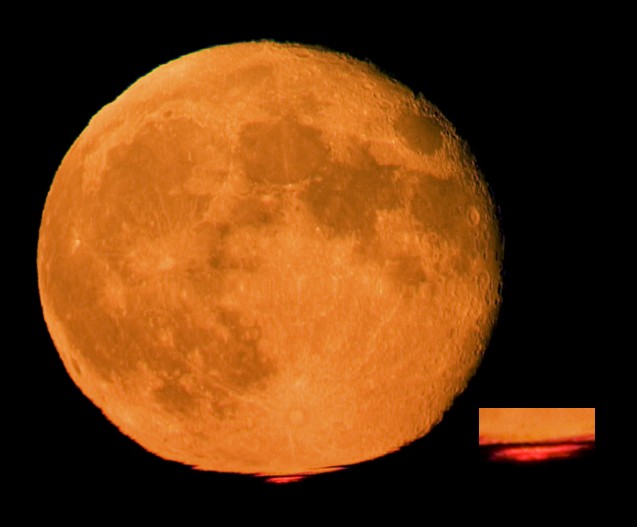
This remarkable telescopic image highlights the deep orange cast of a waning gibbous Moon seen very close to the eastern horizon earlier this week, on September 19. In fact, today's equinox at 22:23 UT marks the beginning of Fall in the Northern Hemisphere and makes this view from Stuttgart, Germany an almost Autumn Moon. While the long sight-line through the atmosphere filters and reddens the moonlight, it also bends different colors of light through slightly different angles, producing noticeable red (bottom) and green (top) lunar rims. Also captured here floating just below the Moon is a thin, red mirage (inset) -- in this case, an atmospherically magnified and distorted image of the red rim. Of course, this tantalizing lunar "red flash" is related to the more commonly seen green flash of the Sun.