The Sun
The Sun is a yellow dwarf star (G2V), about 4.6 billion years old, and the dominant gravitational force in the Solar System. It has a diameter of roughly 1.4 million kilometers and contains around 99.8% of the Solar System’s mass. Nuclear fusion in its core converts hydrogen into helium, producing energy that warms the planets. Above the core lie the radiative and convective zones, followed by the visible photosphere (~5,500 °C), the chromosphere, and the much hotter corona (~2 million °C).
Source: science.nasa.gov
APODs including "The Sun"
Portrait of RY Tauri
23/09/2005
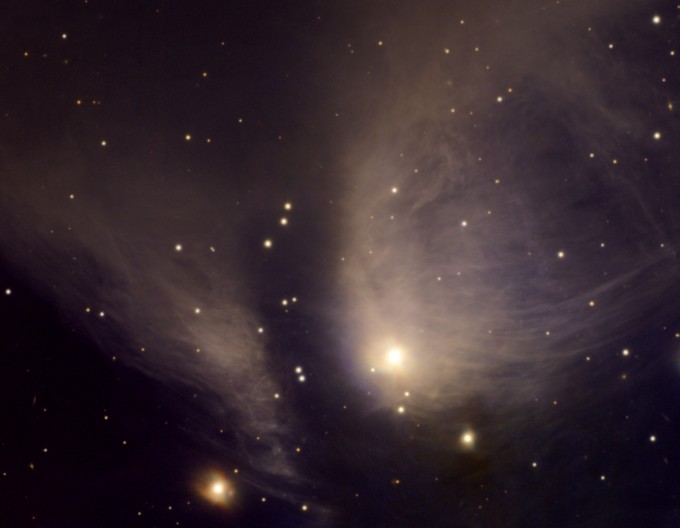
A star emerges from its natal cloud of gas and dust in this tantalizing portrait of RY Tauri, a small stellar nursery at the edge of the Taurus molecular cloud, a mere 450 light-years away. Illuminating a region that spans about 2/3 of a light-year, the youthful, central star is large, cool, and known to vary in brightness. Still collapsing, in a few million years the star's winds will likely clear out the gas and dust clouds, as it settles down to become a steady main sequence star like the Sun. What remains could well include a planetary system. The image data for RY Tauri is from the Gemini Observatory, on Mauna Kea, Hawaii -- based on observations proposed by the Astronomy Club of Dorval, Quebec.