The Sun
The Sun is a yellow dwarf star (G2V), about 4.6 billion years old, and the dominant gravitational force in the Solar System. It has a diameter of roughly 1.4 million kilometers and contains around 99.8% of the Solar System’s mass. Nuclear fusion in its core converts hydrogen into helium, producing energy that warms the planets. Above the core lie the radiative and convective zones, followed by the visible photosphere (~5,500 °C), the chromosphere, and the much hotter corona (~2 million °C).
Source: science.nasa.gov
APODs including "The Sun"
Fountains Discovered on Saturn's Enceladus
05/12/2005
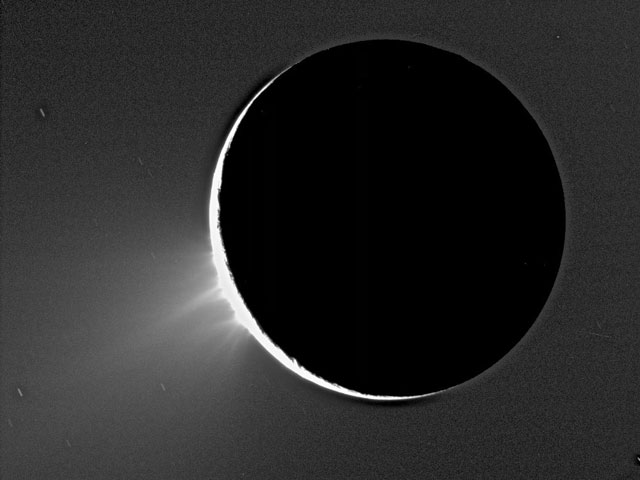
Fountains of ice shoot out from Saturn's moon Enceladus. Clear discovery images of the fountains were made using observations from the robot Cassini spacecraft currently orbiting Saturn. During a recent pass, Cassini was programmed to look back toward the Sun where Enceladus would appear as a thin crescent. From this vantage point, particles emitted from the surface would better show themselves by reflecting sunlight. The tactic was successful -- the above frame shows several plumes emanating from regions previously known to contain gashes in the surface dubbed tiger stripes. Cassini detected an increase in particle emissions from these regions during a July flyby. Some of these ice particles likely contribute to the make up of Saturn's mysterious E ring.