The Sun
The Sun is a yellow dwarf star (G2V), about 4.6 billion years old, and the dominant gravitational force in the Solar System. It has a diameter of roughly 1.4 million kilometers and contains around 99.8% of the Solar System’s mass. Nuclear fusion in its core converts hydrogen into helium, producing energy that warms the planets. Above the core lie the radiative and convective zones, followed by the visible photosphere (~5,500 °C), the chromosphere, and the much hotter corona (~2 million °C).
Source: science.nasa.gov
APODs including "The Sun"
December Moon Meets Evening Star
09/12/2005
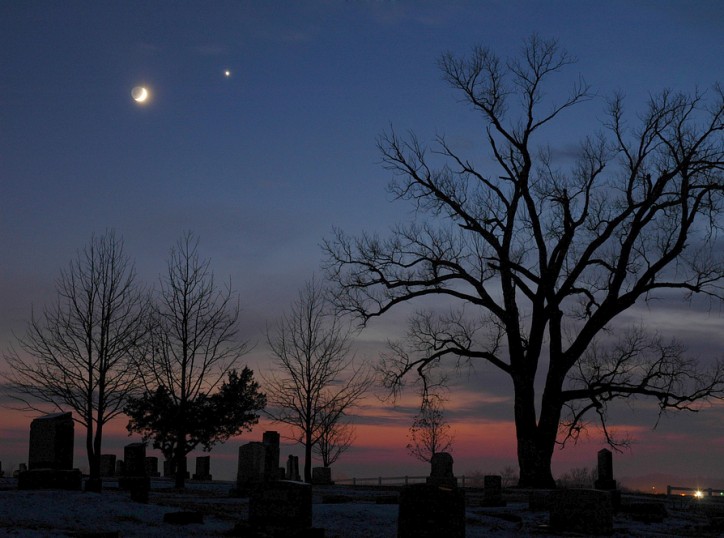
If you've been outdoors near sunset, then you've probably noticed Venus low in the west as the brilliant evening star. Sometimes mistaken for a tower light near the horizon, Venus is the third brightest celestial beacon, after the Sun and Moon, in planet Earth's sky. That distinction is particularly easy to appreciate in this peaceful scene featuring the crescent Moon, Venus, and sunset colors captured on December 4th near Albany, Missouri, USA. As this season's evening star, Venus will be at its most brilliant tonight, but as December progresses the bright planet will begin to fall out of the western sky. By early next week, December's Moon will have moved on to meet another bright planet overhead -- Mars.