The Sun
The Sun is a yellow dwarf star (G2V), about 4.6 billion years old, and the dominant gravitational force in the Solar System. It has a diameter of roughly 1.4 million kilometers and contains around 99.8% of the Solar System’s mass. Nuclear fusion in its core converts hydrogen into helium, producing energy that warms the planets. Above the core lie the radiative and convective zones, followed by the visible photosphere (~5,500 °C), the chromosphere, and the much hotter corona (~2 million °C).
Source: science.nasa.gov
APODs including "The Sun"
Sunrise by Season
21/12/2005
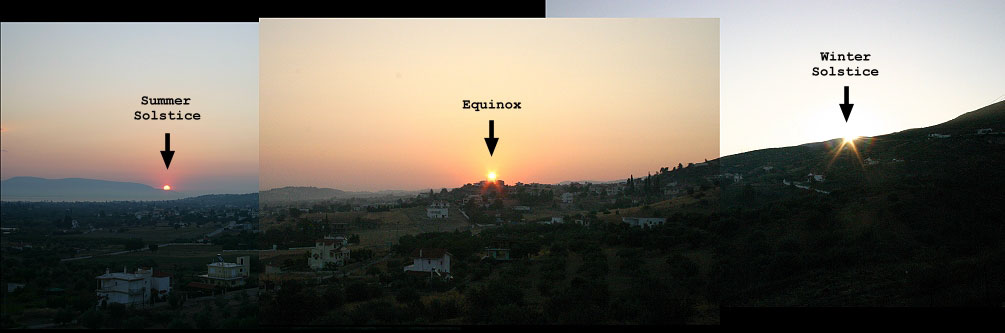
Does the Sun always rise in the same direction? No. As the seasons change, the direction toward the rising Sun will change, too. The Sun will always rise and set furthest to the south during the day of Winter Solstice, and furthest to the north during Summer Solstice. Today is Winter Solstice, the day of least sunlight in the Northern Hemisphere and of most sunlight in the Southern Hemisphere. In many countries, the Winter Solstice brings a change in season, as it is the first day of winter in the North. The solar heating and stored energy in the Earth's surface and atmosphere is near its lowest during winter, making it usually the coldest months of the year. On the brighter side in the north, daylight hours will increase every day from now until June. Pictured above are the different directions of the rising sun throughout the year above a small town in Greece.