The Sun
The Sun is a yellow dwarf star (G2V), about 4.6 billion years old, and the dominant gravitational force in the Solar System. It has a diameter of roughly 1.4 million kilometers and contains around 99.8% of the Solar System’s mass. Nuclear fusion in its core converts hydrogen into helium, producing energy that warms the planets. Above the core lie the radiative and convective zones, followed by the visible photosphere (~5,500 °C), the chromosphere, and the much hotter corona (~2 million °C).
Source: science.nasa.gov
APODs including "The Sun"
Hauoli Makahiki Hou
04/01/2006
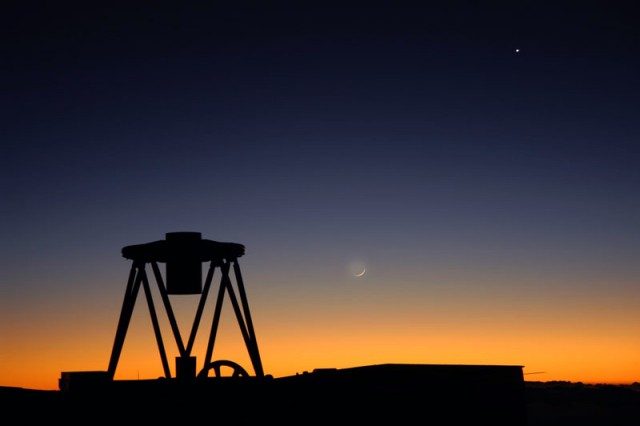
Fading sunlight, a young crescent Moon, and brilliant Venus shared the western sky in this view of 2005's final sunset from the top of Mount Haleakala, on Maui, Hawaii. Also known as the Sacred House of the Sun, Haleakala, is Maui's dormant volcano. At 10,000 feet the summit is an ideal site for astronomical observatories, and this scene also features the silhouette of the northern hemisphere Faulkes Telescope. Of particular interest to students the Faulkes Telescope is a 2-meter diameter instrument, dedicated to astronomy education, that can be remotely operated over the internet. The project is a joint effort between the Dill Faulkes Educational Trust and the University of Hawaii Institute for Astronomy. Of course on Haleakala, "Happy New Year" would be "Hauoli Makahiki hou" (how-oh-lee ma-ka-hee-key ho).