The Sun
The Sun is a yellow dwarf star (G2V), about 4.6 billion years old, and the dominant gravitational force in the Solar System. It has a diameter of roughly 1.4 million kilometers and contains around 99.8% of the Solar System’s mass. Nuclear fusion in its core converts hydrogen into helium, producing energy that warms the planets. Above the core lie the radiative and convective zones, followed by the visible photosphere (~5,500 °C), the chromosphere, and the much hotter corona (~2 million °C).
Source: science.nasa.gov
APODs including "The Sun"
The Phases of Venus
10/01/2006
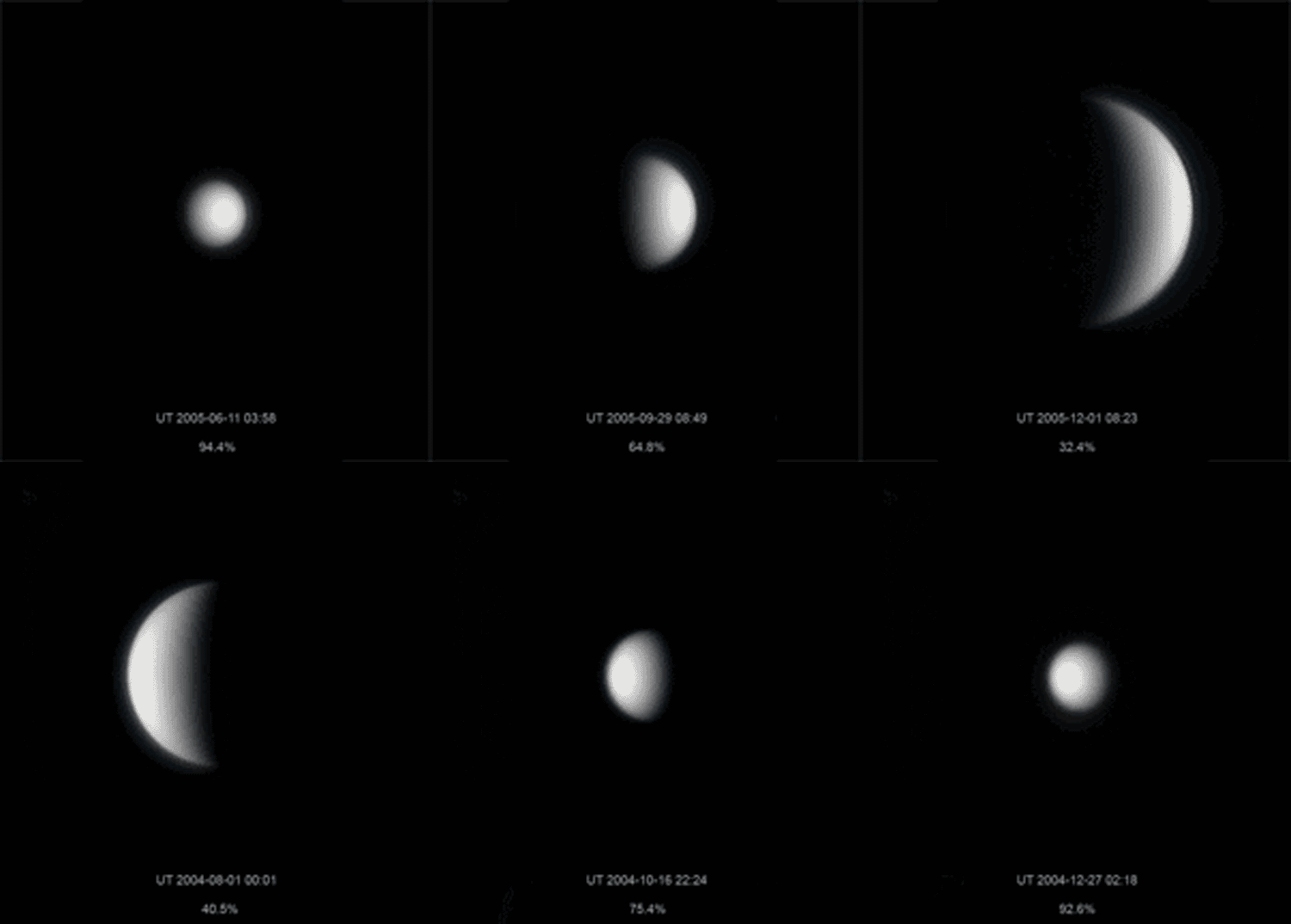
Venus goes through phases. Just like our Moon, Venus can appear as full as a disk or as a thin as a crescent. Venus, frequently the brightest object in the post-sunset or pre-sunrise sky, appears so small, however, that it usually requires binoculars or a small telescope to clearly see its current phase. The above time-lapse sequence, however, was taken over the course of many months and shows not only how Venus changes phase but how it's apparent angular size also changes. In the middle negative image, Venus is in a new phase, the same phase that occurred during its rare partial eclipse of the Sun in 2004.