The Sun
The Sun is a yellow dwarf star (G2V), about 4.6 billion years old, and the dominant gravitational force in the Solar System. It has a diameter of roughly 1.4 million kilometers and contains around 99.8% of the Solar System’s mass. Nuclear fusion in its core converts hydrogen into helium, producing energy that warms the planets. Above the core lie the radiative and convective zones, followed by the visible photosphere (~5,500 °C), the chromosphere, and the much hotter corona (~2 million °C).
Source: science.nasa.gov
APODs including "The Sun"
Saturn in the Hive
28/01/2006
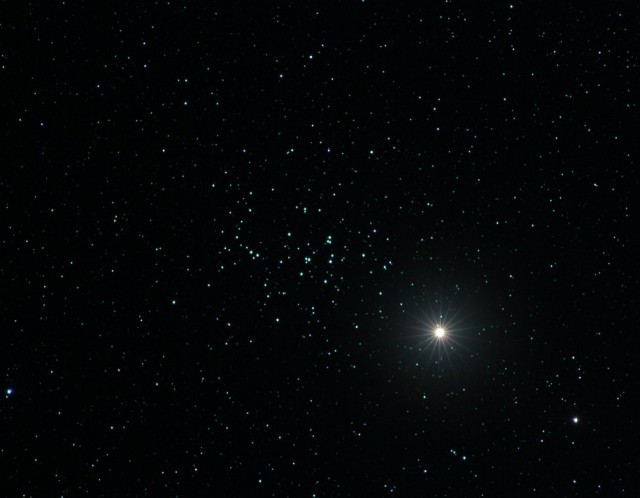
If you can find Saturn in tonight's sky, then you can also find M44, popularly known as the Beehive star cluster. In fact, with a pair of binoculars most casual skygazers should find it fairly easy to zero in on this celestial scene. Saturn is at opposition - opposite the Sun in Earth's sky - so, the bright planet rises in the east at sunset and is visible throughout the night. Near the stationary part of its wandering path through the heavens, Saturn will obligingly linger for a while in the vicinity of M44 in the relatively faint constellation Cancer. Seen here in a photograph from January 25, Saturn (lower right) is strongly overexposed with the stars of M44 swarming above and to the left. The picture approximately corresponds to the view when looking through a typical pair of binoculars. Saturn is about 64 light-minutes from our fair planet while M44, one of the closest star clusters, is around 600 light-years away.