The Sun
The Sun is a yellow dwarf star (G2V), about 4.6 billion years old, and the dominant gravitational force in the Solar System. It has a diameter of roughly 1.4 million kilometers and contains around 99.8% of the Solar System’s mass. Nuclear fusion in its core converts hydrogen into helium, producing energy that warms the planets. Above the core lie the radiative and convective zones, followed by the visible photosphere (~5,500 °C), the chromosphere, and the much hotter corona (~2 million °C).
Source: science.nasa.gov
APODs including "The Sun"
McCool Hill on Mars
15/03/2006
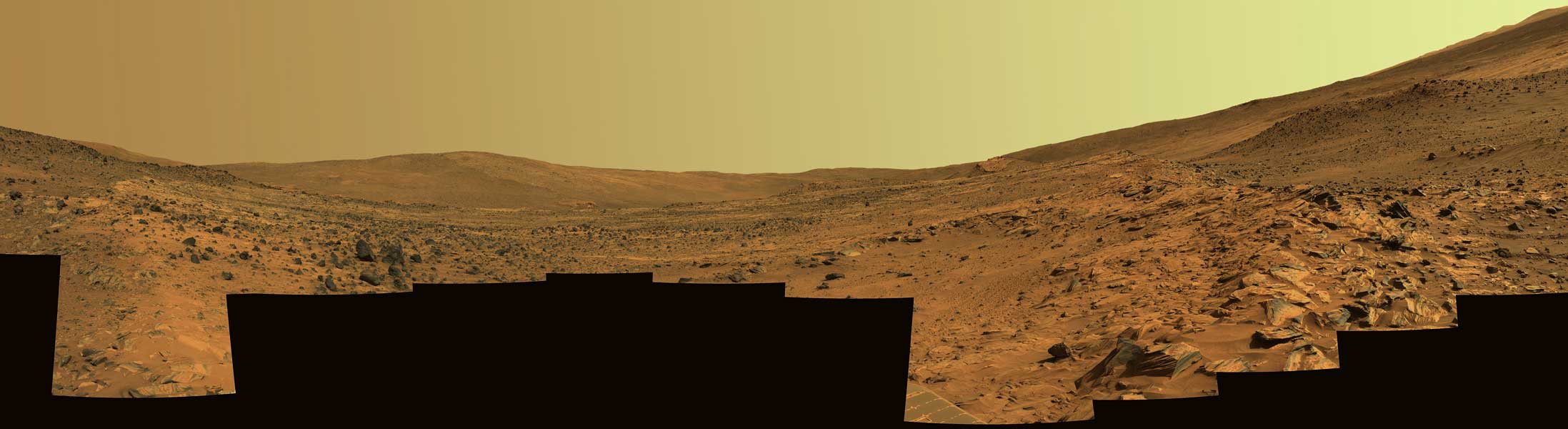
You can make it. Winter is rapidly advancing on the southern hemisphere on Mars, and the lack of sunlight could be dangerous unless you find a good place to hibernate. There it is ahead: McCool Hill. As the robotic Spirit rover rolling across Mars, you are told that this will be a good place to spend the Martian winter. On the north slope of McCool Hill, you can tilt your solar panels toward the Sun enough to generate the power you need to keep running through the winter. Between you and McCool Hill is an unusual reddish outcropping of rocks. Also visible above, unusual layered rocks lie to your right, while other scattered rocks appear either smooth or sponge-like. Fortunately, there is still some time to explore, and the landscape before you may hold more clues to the history of ancient Mars.