The Sun
The Sun is a yellow dwarf star (G2V), about 4.6 billion years old, and the dominant gravitational force in the Solar System. It has a diameter of roughly 1.4 million kilometers and contains around 99.8% of the Solar System’s mass. Nuclear fusion in its core converts hydrogen into helium, producing energy that warms the planets. Above the core lie the radiative and convective zones, followed by the visible photosphere (~5,500 °C), the chromosphere, and the much hotter corona (~2 million °C).
Source: science.nasa.gov
APODs including "The Sun"
Hideaway
20/06/2006
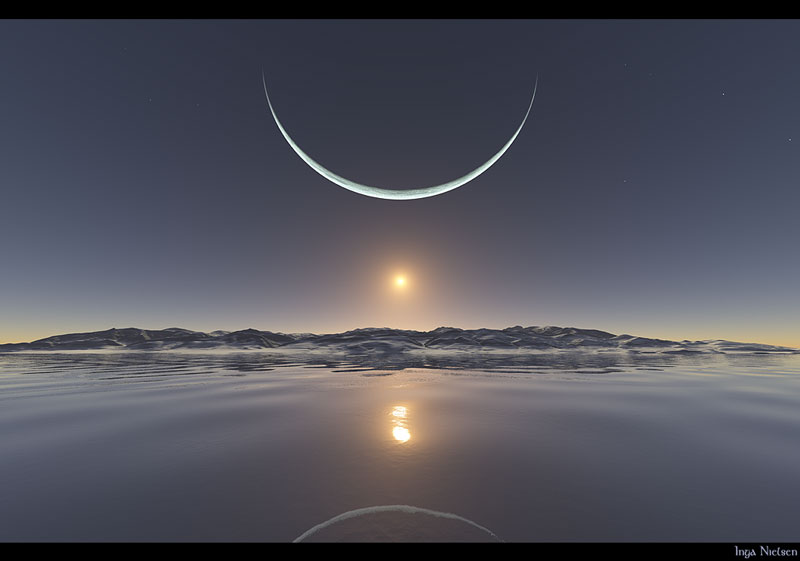
Is this a picture of a sunset from Earth's North Pole? Regardless of urban legends circulating the Internet, the answer is no. The above scene was drawn to be an imaginary celestial place that would be calm and peaceful, and therefore titled Hideaway. The scene could not exist anywhere on the Earth because from the Earth, the Moon and the Sun always have nearly the same angular size. This is particularly apparent, for example, during solar eclipses. Still, the scene drawn is quite striking, and the crescent part of the "moon" shown is approximately accurate given the location of the parent star. In reality, the North Pole of Earth looks different. Starting earlier this month, the North Pole even has a web camera returning near-live pictures.