The Sun
The Sun is a yellow dwarf star (G2V), about 4.6 billion years old, and the dominant gravitational force in the Solar System. It has a diameter of roughly 1.4 million kilometers and contains around 99.8% of the Solar System’s mass. Nuclear fusion in its core converts hydrogen into helium, producing energy that warms the planets. Above the core lie the radiative and convective zones, followed by the visible photosphere (~5,500 °C), the chromosphere, and the much hotter corona (~2 million °C).
Source: science.nasa.gov
APODs including "The Sun"
The Moving Moons of Saturn
27/06/2006
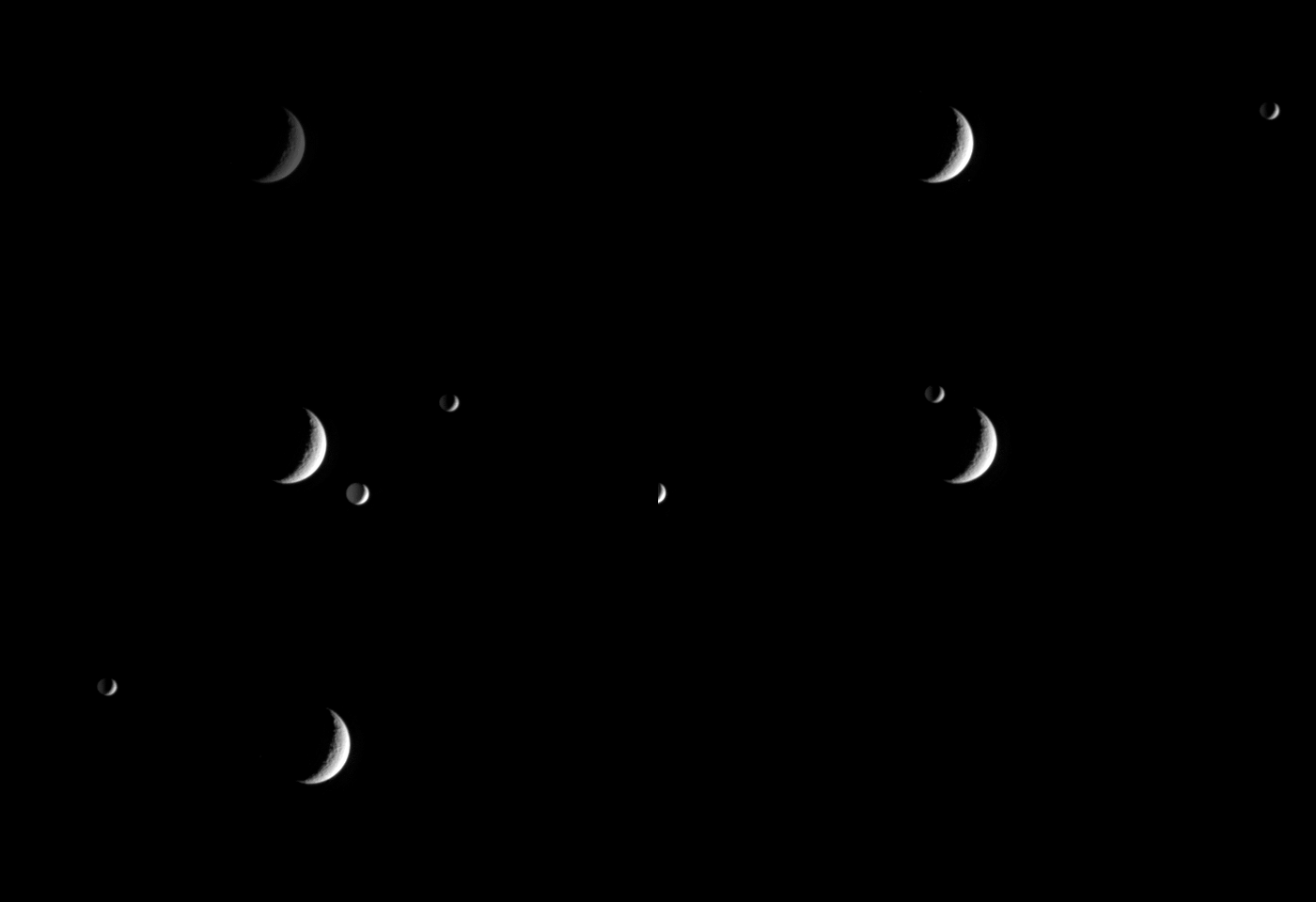
The moons of Saturn never stop. A space traveler orbiting the ringed giant planet would witness a continuing silent dance where Saturn's multiple moons pass near each other in numerous combinations. Like a miniature Solar System, the innermost moons orbit Saturn the fastest. The above movie was centered on Saturn's moon Rhea, so that the moons Mimas and Enceladus appear to glide by. At 1,500 kilometers across, Rhea is over three times larger than the comparably sized Mimas and Enceladus. The Sun illuminates the scene from the lower right, giving all of the moons the same crescent phase. The above time lapse movie was created by the Saturn-orbiting robotic Cassini spacecraft over a period of about 40 minutes.