The Sun
The Sun is a yellow dwarf star (G2V), about 4.6 billion years old, and the dominant gravitational force in the Solar System. It has a diameter of roughly 1.4 million kilometers and contains around 99.8% of the Solar System’s mass. Nuclear fusion in its core converts hydrogen into helium, producing energy that warms the planets. Above the core lie the radiative and convective zones, followed by the visible photosphere (~5,500 °C), the chromosphere, and the much hotter corona (~2 million °C).
Source: science.nasa.gov
APODs including "The Sun"
The View toward Husband Hill on Mars
03/07/2006
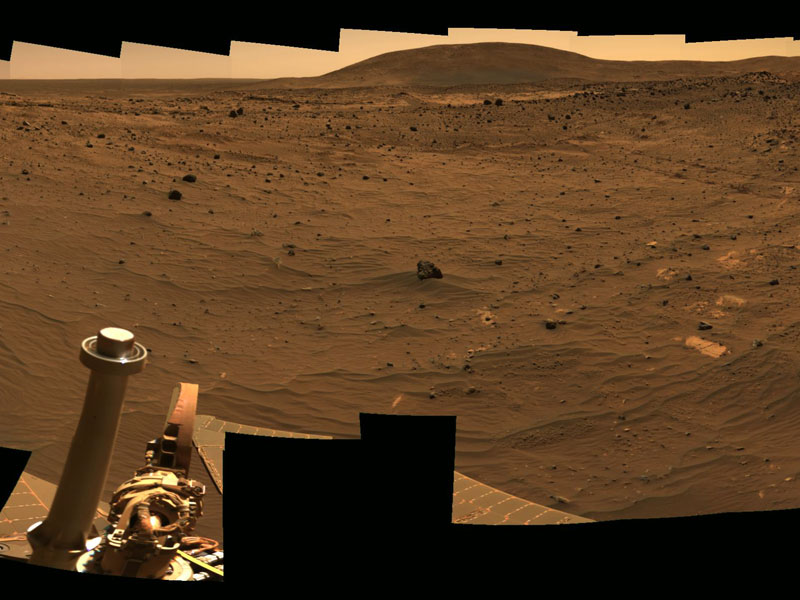
This Martian vista is only part of one of the greatest panoramic views of Mars that has ever been attempted. The expansive mosaic is helping to keep the robotic Spirit rover busy over the energy draining winter in the southern hemisphere of Mars. During the winter, Spirit is constrained to stay on the side of McCool Hill in order to keep its solar panels pointed toward the Sun. The panorama has so far involved over 800 exposures, very little digital compression, and will take over a month to complete. The view shown is toward Husband Hill, a hill that Spirit climbed last year. A careful inspection of the above image shows tracks crossing from the center to the right.