The Sun
The Sun is a yellow dwarf star (G2V), about 4.6 billion years old, and the dominant gravitational force in the Solar System. It has a diameter of roughly 1.4 million kilometers and contains around 99.8% of the Solar System’s mass. Nuclear fusion in its core converts hydrogen into helium, producing energy that warms the planets. Above the core lie the radiative and convective zones, followed by the visible photosphere (~5,500 °C), the chromosphere, and the much hotter corona (~2 million °C).
Source: science.nasa.gov
APODs including "The Sun"
Crescent Rhea Occults Crescent Saturn
11/07/2006
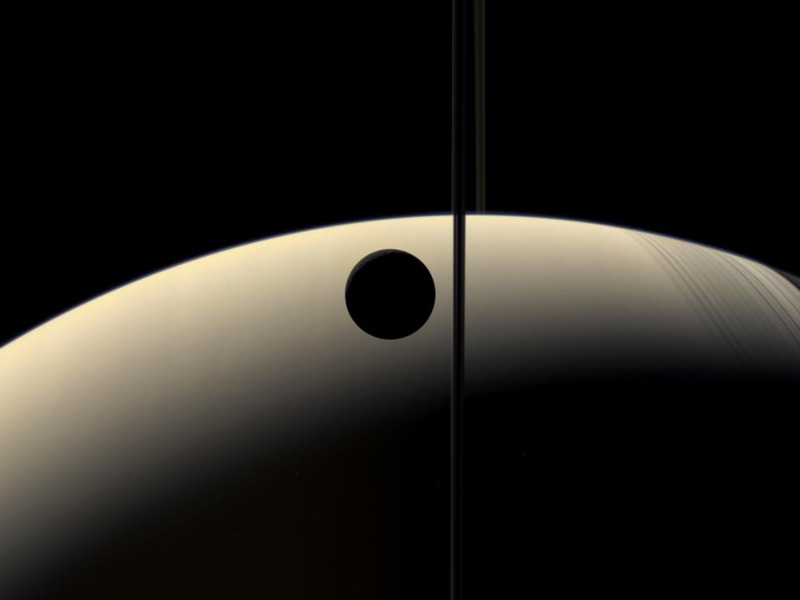
Soft hues, partially lit orbs, a thin trace of the ring, and slight shadows highlight this understated view of the majestic surroundings of the giant planet Saturn. Looking nearly back toward the Sun, the robot Cassini spacecraft now orbiting Saturn captured crescent phases of Saturn and its moon Rhea in color a few months ago. As striking as the above image is, it is but a single frame from a recently released 60-frame silent movie where Rhea can be seen gliding in front of its parent world. Since Cassini was nearly in the plane of Saturn's rings, the normally impressive rings are visible here only as a thin line across the image center. Cassini has now passed the official half-way mark of its mission around Saturn, but is well situated to complete another two years investigating this complex and surprising system.