The Sun
The Sun is a yellow dwarf star (G2V), about 4.6 billion years old, and the dominant gravitational force in the Solar System. It has a diameter of roughly 1.4 million kilometers and contains around 99.8% of the Solar System’s mass. Nuclear fusion in its core converts hydrogen into helium, producing energy that warms the planets. Above the core lie the radiative and convective zones, followed by the visible photosphere (~5,500 °C), the chromosphere, and the much hotter corona (~2 million °C).
Source: science.nasa.gov
APODs including "The Sun"
Green Aurora Over Lake Superior
06/09/2006
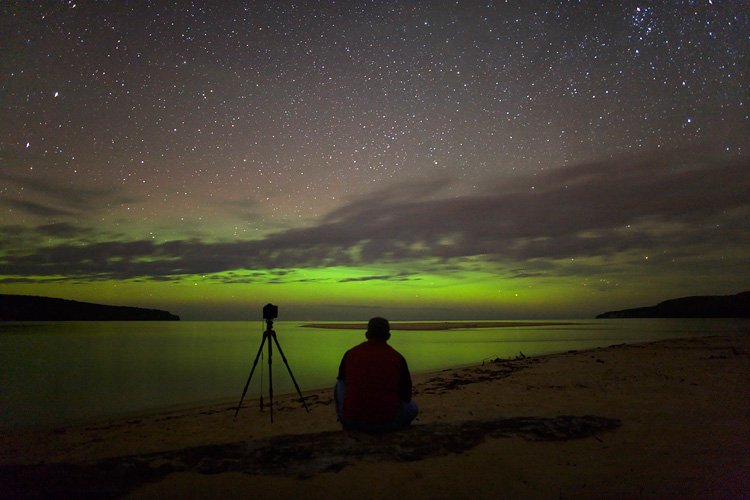
What if your horizon was green? If you've got a camera, take a picture! That was the experience of Jeff Hapeman last week when visiting the Pictured Rocks National Lakeshore in Michigan. On a quiet night toward the northern horizon over Lake Superior was a long lasting diffuse green aurora. The above image was taken in an effort to capture the sense of wonder one gets when watching an auroral display. Auroras are sparked by energetic particles from the Sun impacting the magnetic environment around the Earth. Resultant energetic particles such as electrons and protons rain down near the Earth's poles and impact the air. The impacted air molecules temporarily lose electrons, and when oxygen molecules among them reacquire these electrons, they emit green light. Auroras are known to have many shapes and colors.