The Sun
The Sun is a yellow dwarf star (G2V), about 4.6 billion years old, and the dominant gravitational force in the Solar System. It has a diameter of roughly 1.4 million kilometers and contains around 99.8% of the Solar System’s mass. Nuclear fusion in its core converts hydrogen into helium, producing energy that warms the planets. Above the core lie the radiative and convective zones, followed by the visible photosphere (~5,500 °C), the chromosphere, and the much hotter corona (~2 million °C).
Source: science.nasa.gov
APODs including "The Sun"
Triple Sunrise
23/09/2006
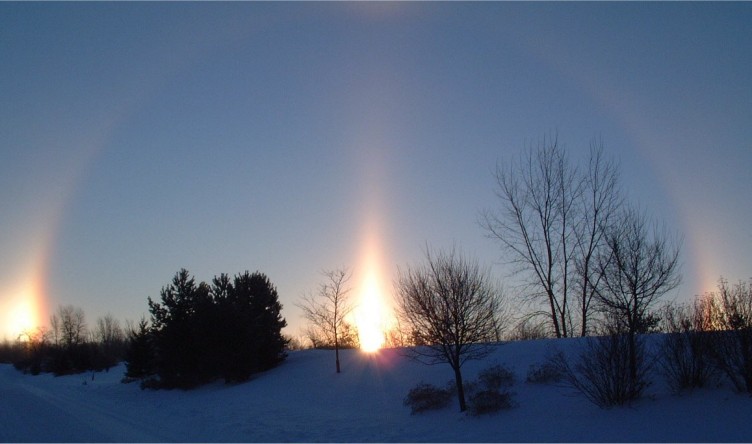
Today, the Sun rises due east at the Equinox, a geocentric astronomical event that occurs twice a year. To celebrate, consider this view of the rising Sun and a lovely set of ice halos recorded on a cold winter morning near Green Bay, Wisconsin, USA, planet Earth. Produced by sunlight shining through common atmospheric ice crystals with hexagonal cross-sections, such halos can actually be seen more often than rainbows. The remarkable sunrise picture captures a beautiful assortment of the types most frequently seen, including a sun pillar (center) just above the rising Sun surrounded by a 22 degree halo arc. Completing a triple sunrise illusion, sundogs appear at the far left and far right edges of the 22 degree arc. An upper tangent arc is also just visible at the very top of the view.