The Sun
The Sun is a yellow dwarf star (G2V), about 4.6 billion years old, and the dominant gravitational force in the Solar System. It has a diameter of roughly 1.4 million kilometers and contains around 99.8% of the Solar System’s mass. Nuclear fusion in its core converts hydrogen into helium, producing energy that warms the planets. Above the core lie the radiative and convective zones, followed by the visible photosphere (~5,500 °C), the chromosphere, and the much hotter corona (~2 million °C).
Source: science.nasa.gov
APODs including "The Sun"
Alpha Cam: Runaway Star
24/11/2006
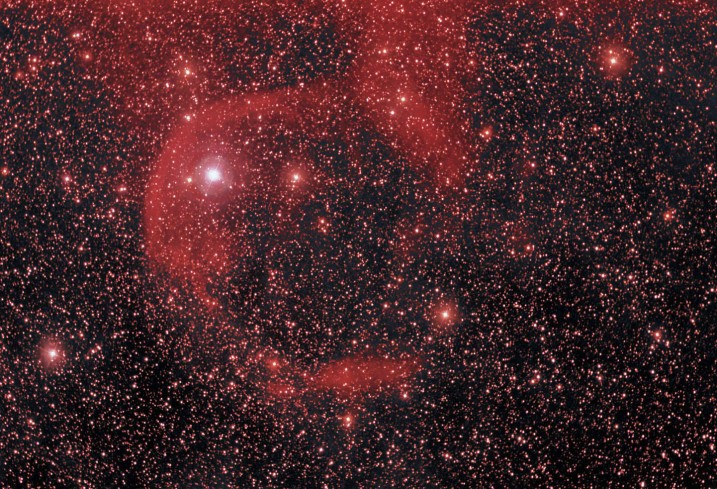
Runaway stars are massive stars traveling rapidly through interstellar space. Like a ship plowing through cosmic seas, runaway star Alpha Cam has produced this graceful arcing bow wave or bow shock - moving at over 60 kilometers per second and compressing the interstellar material in its path. The bright star above and left of center in this wide (3x2 degree) view, Alpha Cam is about 25-30 times as massive as the Sun, 5 times hotter (30,000 kelvins), and over 500,000 times brighter. About 4,000 light-years away in the long-necked constellation Camelopardalis, the star also produces a strong wind. The bow shock stands off about 10 light-years from the star itself. What set this star in motion? Astronomers have long thought that Alpha Cam was flung out of a nearby cluster of young hot stars due to gravitational interactions with other cluster members or perhaps by the supernova explosion of a massive companion star.