The Sun
The Sun is a yellow dwarf star (G2V), about 4.6 billion years old, and the dominant gravitational force in the Solar System. It has a diameter of roughly 1.4 million kilometers and contains around 99.8% of the Solar System’s mass. Nuclear fusion in its core converts hydrogen into helium, producing energy that warms the planets. Above the core lie the radiative and convective zones, followed by the visible photosphere (~5,500 °C), the chromosphere, and the much hotter corona (~2 million °C).
Source: science.nasa.gov
APODs including "The Sun"
The View from Stereo Ahead
22/12/2006
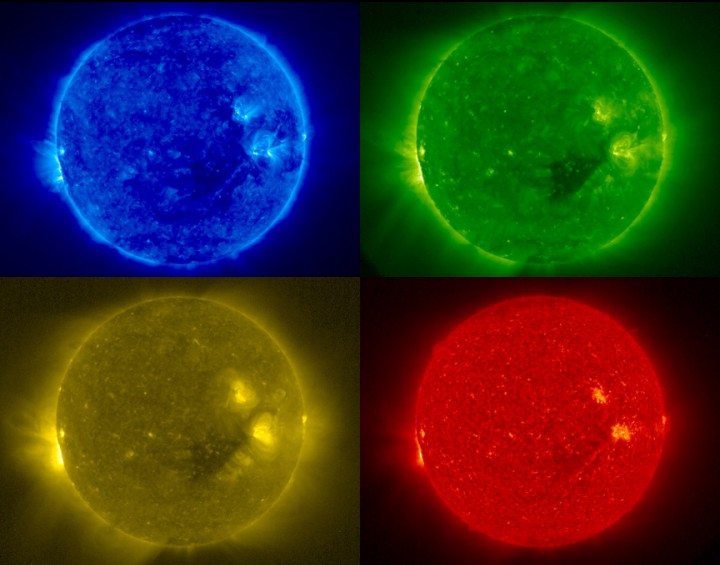
On December 22nd, at 0022 Universal Time the Sun reached its southernmost point in Earth's sky marking the final season change for the year 2006. In celebration of the Solstice, consider these images of the Sun from an extreme ultraviolet telescope onboard the Stereo Ahead spacecraft. Recorded on December 4th, Stereo's first day of imaging, each false-color view highlights atomic emission in different temperature regimes of the upper solar atmosphere; 2 million kelvins in yellow, 1.5 million in green, 1 million, in blue and 60 to 80 thousand in red. The Stereo Mission will place twin spacecraft, launched together in October, into different solar orbits to conduct a three dimensional exploration of the Sun and the solar environment. After completing lunar swingby maneuvers, the A spacecraft is intended to orbit the Sun "Ahead" of planet Earth, and the B spacecraft "Behind".