The Sun
The Sun is a yellow dwarf star (G2V), about 4.6 billion years old, and the dominant gravitational force in the Solar System. It has a diameter of roughly 1.4 million kilometers and contains around 99.8% of the Solar System’s mass. Nuclear fusion in its core converts hydrogen into helium, producing energy that warms the planets. Above the core lie the radiative and convective zones, followed by the visible photosphere (~5,500 °C), the chromosphere, and the much hotter corona (~2 million °C).
Source: science.nasa.gov
APODs including "The Sun"
The Gegenschein
26/12/2006
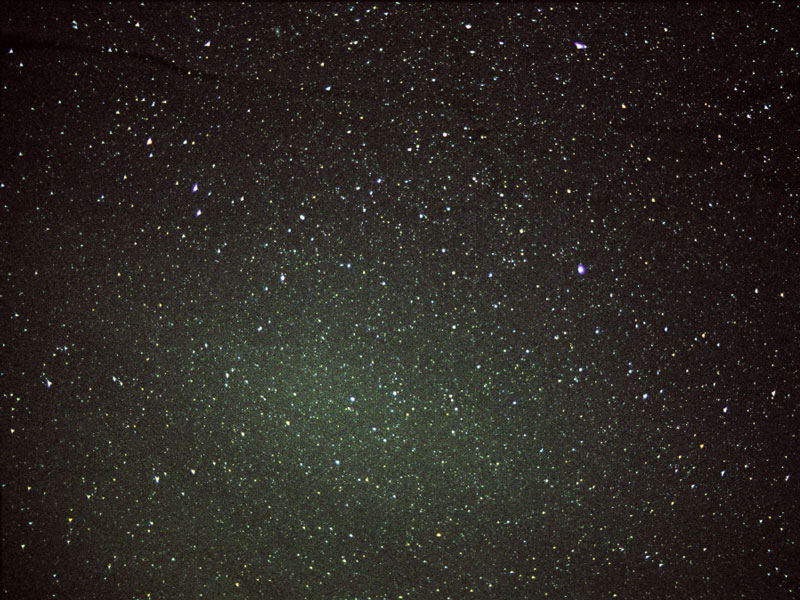
If you look carefully enough, you can even see the glow of the Sun in the opposite direction. At night this glow is known as the gegenschein (German for "counter glow"), and can be seen as a faint glow in an extremely dark sky. The gegenschein is sunlight back-scattered off small interplanetary dust particles. These dust particles are millimeter sized splinters from asteroids and orbit in the ecliptic plane of the planets. Pictured above, the gegenschein is seen superposed toward the constellation of Pisces. The gegenschein is distinguished from zodiacal light by the high angle of reflection. During the day, a phenomenon similar to the gegenschein called the glory can be seen in reflecting air or clouds opposite the Sun from an airplane.