The Sun
The Sun is a yellow dwarf star (G2V), about 4.6 billion years old, and the dominant gravitational force in the Solar System. It has a diameter of roughly 1.4 million kilometers and contains around 99.8% of the Solar System’s mass. Nuclear fusion in its core converts hydrogen into helium, producing energy that warms the planets. Above the core lie the radiative and convective zones, followed by the visible photosphere (~5,500 °C), the chromosphere, and the much hotter corona (~2 million °C).
Source: science.nasa.gov
APODs including "The Sun"
Collinder 399: The Coat Hanger
12/01/2007
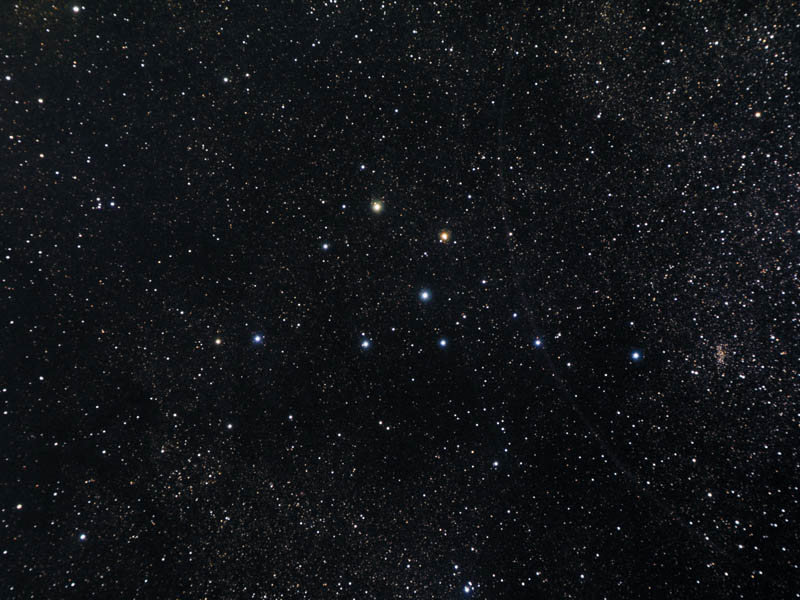
Is this coat hanger a star cluster or an asterism? This cosmic hang-up has been debated over much of last century, as astronomers wondered whether this binocular-visible object is really a physically associated open cluster or a chance projection. Chance star projections are known as asterisms, an example of which is the popular Big Dipper. Recent precise measurements from different vantage points in the Earth's orbit around the Sun have recently uncovered discrepant angular shifts indicating that the Coat Hanger is better described as an asterism. Known more formally as Collinder 399, this bright stellar grouping can be seen spanning more than a full moon toward the direction of the constellation of the Fox (Vulpecula). On the far right of the above image is the open cluster of stars NGC 6802.