The Sun
The Sun is a yellow dwarf star (G2V), about 4.6 billion years old, and the dominant gravitational force in the Solar System. It has a diameter of roughly 1.4 million kilometers and contains around 99.8% of the Solar System’s mass. Nuclear fusion in its core converts hydrogen into helium, producing energy that warms the planets. Above the core lie the radiative and convective zones, followed by the visible photosphere (~5,500 °C), the chromosphere, and the much hotter corona (~2 million °C).
Source: science.nasa.gov
APODs including "The Sun"
A Comet Tail Horizon
24/01/2007
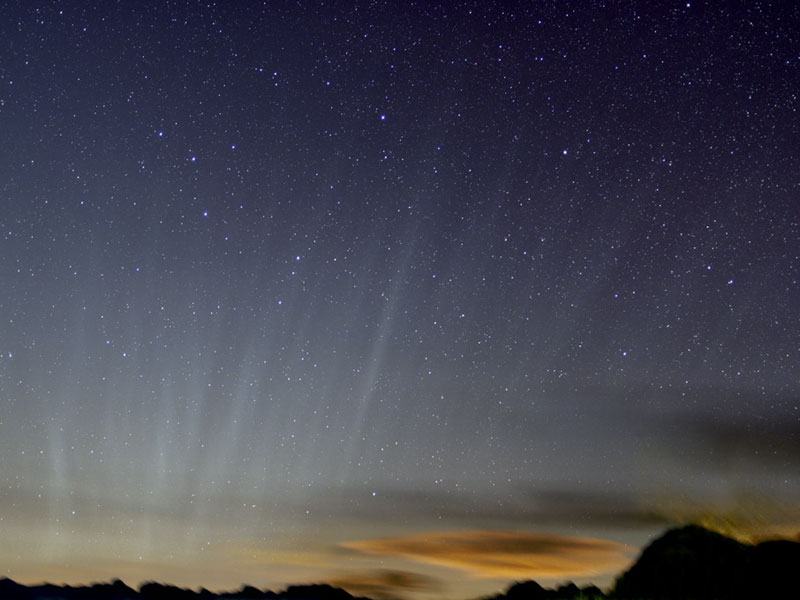
What's happening over the horizon? Many a sky enthusiast who thought they had seen it all had never seen anything like this. To the surprise of many Northern Hemisphere observers, the tail of Comet McNaught remained visible even after the comet's head set ahead of the Sun. What's more, visible were bright but extremely rare filamentary striae from the comet's expansive dust tail. The cause of dust tail striae are not known for sure, but are possibly related to fragmentation of comet's nucleus. The last comet to show prominent striae was Comet Hale-Bopp in 1997. Pictured above, the tail of Comet McNaught was caught just after sunset last Friday above the Carnic Alps of northern Italy.