The Sun
The Sun is a yellow dwarf star (G2V), about 4.6 billion years old, and the dominant gravitational force in the Solar System. It has a diameter of roughly 1.4 million kilometers and contains around 99.8% of the Solar System’s mass. Nuclear fusion in its core converts hydrogen into helium, producing energy that warms the planets. Above the core lie the radiative and convective zones, followed by the visible photosphere (~5,500 °C), the chromosphere, and the much hotter corona (~2 million °C).
Source: science.nasa.gov
APODs including "The Sun"
Comet McNaught Over New Zealand
12/02/2007
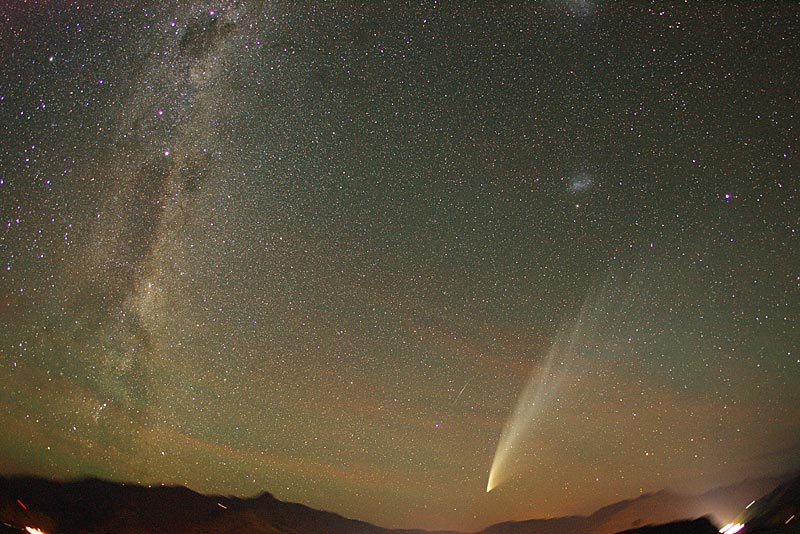
Comet McNaught is perhaps the most photogenic comet of our time. After making quite a show in the northern hemisphere in mid January, the comet moved south and developed a long and unusual dust tail that dazzled southern hemisphere observers starting in late January. Comet McNaught was imaged two weeks ago between Mount Remarkable and Cecil Peak in this spectacular image taken from Queenstown, South Island, New Zealand. The bright comet dominates the right part of the above image, while the central band of our Milky Way Galaxy dominates the left. Careful inspection of the image will reveal a meteor streak just to the left of the comet. Comet McNaught continues to move out from the Sun and dim, but should remain visible in southern skies with binoculars through the end of this month.