The Sun
The Sun is a yellow dwarf star (G2V), about 4.6 billion years old, and the dominant gravitational force in the Solar System. It has a diameter of roughly 1.4 million kilometers and contains around 99.8% of the Solar System’s mass. Nuclear fusion in its core converts hydrogen into helium, producing energy that warms the planets. Above the core lie the radiative and convective zones, followed by the visible photosphere (~5,500 °C), the chromosphere, and the much hotter corona (~2 million °C).
Source: science.nasa.gov
APODs including "The Sun"
Eclipse and Ecliptic
09/03/2007
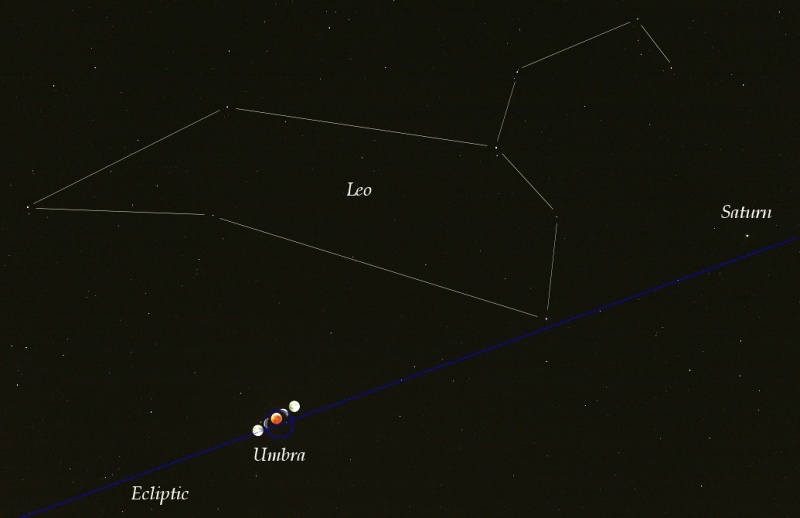
When a Full Moon lies near the ecliptic there can be a lunar eclipse. That cosmic alignment is well illustrated in this composite of eclipse images recorded last Saturday near Paris, France. The projection of the ecliptic plane, the plane of planet Earth's orbit around the Sun, is traced by the long blue line running diagonally through the picture. At a small angle to the ecliptic, along the Moon's orbit, are a series of images from the eclipse itself following the Moon as it moves (down and left) through Earth's shadow. A small blue circle centered on the ecliptic outlines the extent of the dark region of the shadow or umbra. Above, the principal stars of Leo are highlighted, while at the far right lies another celestial wanderer that stays close to the ecliptic - Saturn.