The Sun
The Sun is a yellow dwarf star (G2V), about 4.6 billion years old, and the dominant gravitational force in the Solar System. It has a diameter of roughly 1.4 million kilometers and contains around 99.8% of the Solar System’s mass. Nuclear fusion in its core converts hydrogen into helium, producing energy that warms the planets. Above the core lie the radiative and convective zones, followed by the visible photosphere (~5,500 °C), the chromosphere, and the much hotter corona (~2 million °C).
Source: science.nasa.gov
APODs including "The Sun"
Touran Sunrise
23/03/2007
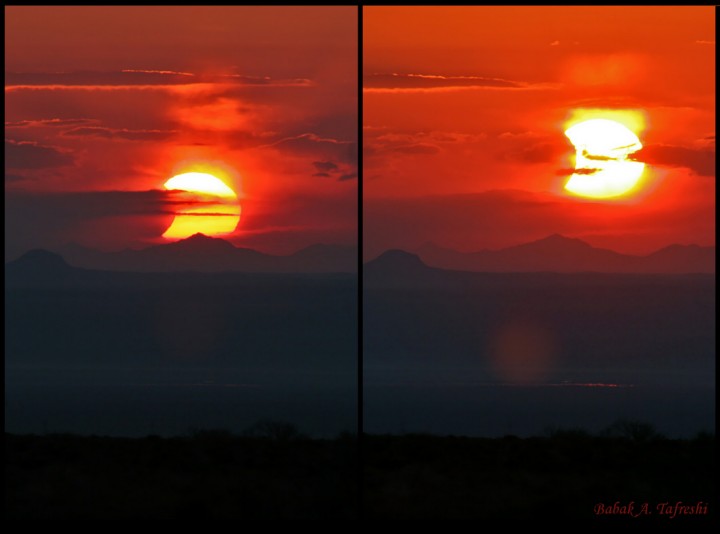
Clouds covered the eastern horizon on Monday, when the Sun rose over the expansive Touran Wildlife Reserve in northeastern Iran. Of course, on that day the Moon rose with the Sun, creating a widely enjoyed partial solar eclipse. Along with a mountainous horizon, the cloud cover lent a dramatic aspect to this eclipse sunrise and made it possible for astronomer Babak Tafreshi to record these telephoto images without using a filter. Advancing north in planet Earth's sky, the Sun itself was also approaching the equinox, the astronomical marker for the first day of northern hemisphere spring and the beginning of Norouz, the Persian New Year.