The Sun
The Sun is a yellow dwarf star (G2V), about 4.6 billion years old, and the dominant gravitational force in the Solar System. It has a diameter of roughly 1.4 million kilometers and contains around 99.8% of the Solar System’s mass. Nuclear fusion in its core converts hydrogen into helium, producing energy that warms the planets. Above the core lie the radiative and convective zones, followed by the visible photosphere (~5,500 °C), the chromosphere, and the much hotter corona (~2 million °C).
Source: science.nasa.gov
APODs including "The Sun"
An Active Sunspot Viewed Sideways
02/04/2007
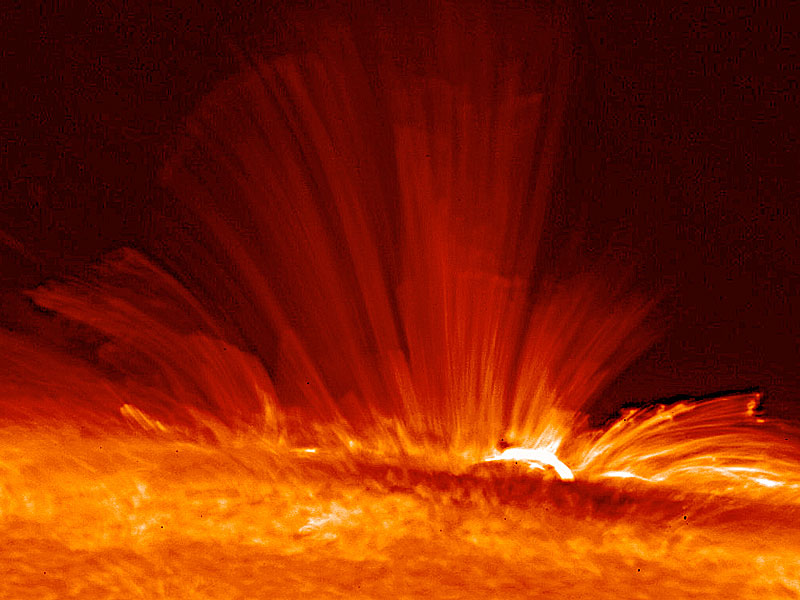
Why are there dark spots on the sun? Although noted for thousands of years, sunspots have been known for decades to be regions of the Sun that are slightly depressed and cooled by the Sun's complex and changing magnetic field. High resolution pictures like the above image from Japan's new Sun-watching Hinode satellite, however, are helping to increase modern understanding. In the center of the above image is a sunspot, but not seen in the usual orientation --this sunspot is seen sideways. Of particular interest is erupting glowing gas that shows how the Sun's magnetic field comes right out of the spot center, but curves markedly around the spot edges. Better understanding of how the Sun ejects particles into space may result in more accurate predictions of solar storms that affect satellites, astronauts, and even power grids on Earth.