The Sun
The Sun is a yellow dwarf star (G2V), about 4.6 billion years old, and the dominant gravitational force in the Solar System. It has a diameter of roughly 1.4 million kilometers and contains around 99.8% of the Solar System’s mass. Nuclear fusion in its core converts hydrogen into helium, producing energy that warms the planets. Above the core lie the radiative and convective zones, followed by the visible photosphere (~5,500 °C), the chromosphere, and the much hotter corona (~2 million °C).
Source: science.nasa.gov
APODs including "The Sun"
A Visit from Atlantis
28/06/2007
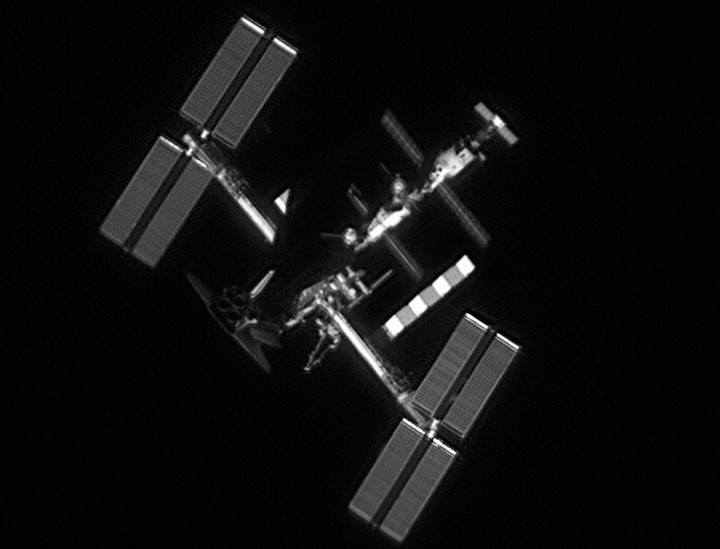
This remarkable image of the space shuttle orbiter Atlantis docked with the International Space Station (ISS) was taken at a range of 190 nautical miles. To record the fast moving pair, last week astronomers at Clay Center Observatory, near Boston, Massachusetts, planet Earth, used a satellite tracking system and 25-inch diameter telescope in combination with a digital video camera. In the sharp picture, Atlantis is below and left of center. The aft view shows three main engines just below its vertical tail glinting in the sunlight. With the Sun shining from below, the body of the orbiter casts a long shadow across the ISS itself and impressive details of the ISS solar arrays used for power generation are easily visible. The large set of solar arrays installed at the lower right was delivered during this visit from Atlantis.