The Sun
The Sun is a yellow dwarf star (G2V), about 4.6 billion years old, and the dominant gravitational force in the Solar System. It has a diameter of roughly 1.4 million kilometers and contains around 99.8% of the Solar System’s mass. Nuclear fusion in its core converts hydrogen into helium, producing energy that warms the planets. Above the core lie the radiative and convective zones, followed by the visible photosphere (~5,500 °C), the chromosphere, and the much hotter corona (~2 million °C).
Source: science.nasa.gov
APODs including "The Sun"
Star Cluster Messier 67
09/08/2007
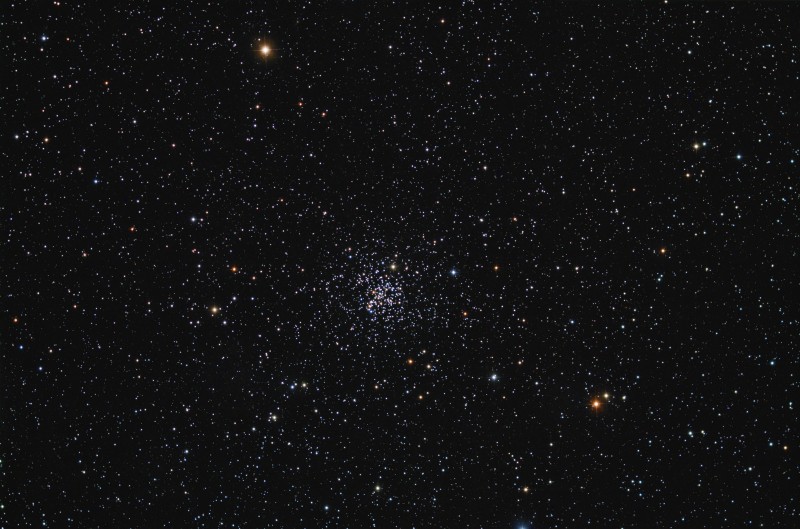
Gathered at the center of this sharp skyview are the stars of Messier 67, one of the oldest known open star clusters. In fact, though open star clusters are usually much younger, the stars of M67 are likely around 4 billion years old, about the same age and with about the same elemental abundances as the Sun. Open clusters are almost always younger because they are dispersed over time as they encounter other stars, interstellar clouds, and experience gravitational tides while orbiting the center of our galaxy. Still, M67 contains over 500 stars or so and lies some 2,800 light-years away in the constellation Cancer. At that estimated distance, M67 would be about 12 light-years across.