The Sun
The Sun is a yellow dwarf star (G2V), about 4.6 billion years old, and the dominant gravitational force in the Solar System. It has a diameter of roughly 1.4 million kilometers and contains around 99.8% of the Solar System’s mass. Nuclear fusion in its core converts hydrogen into helium, producing energy that warms the planets. Above the core lie the radiative and convective zones, followed by the visible photosphere (~5,500 °C), the chromosphere, and the much hotter corona (~2 million °C).
Source: science.nasa.gov
APODs including "The Sun"
Dark Lunar Eclipse
30/08/2007
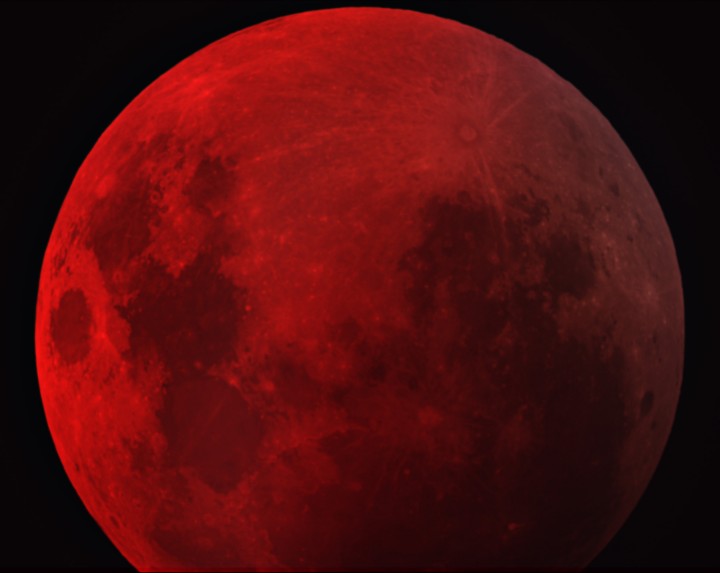
The Moon passed close to the center of Earth's shadow on August 28th. Seen best by skywatchers in western North America, and the Pacific region, the resulting total lunar eclipse was a dark one, lasting about 90 minutes. In this telescopic image taken near mid totality from Yass, NSW Australia, the 85 kilometer wide ray crater Tycho lies near the top right of the shadowed lunar surface. Of course, even during a total lunar eclipse,the Moon is not completely dark. Instead the Moon remains visible during totality, reflecting reddened light filtering into the Earth's shadow. The light comes from all the sunsets and sunrises, as seen from the lunar perspective, around the edges of a silhouetted Earth.