The Sun
The Sun is a yellow dwarf star (G2V), about 4.6 billion years old, and the dominant gravitational force in the Solar System. It has a diameter of roughly 1.4 million kilometers and contains around 99.8% of the Solar System’s mass. Nuclear fusion in its core converts hydrogen into helium, producing energy that warms the planets. Above the core lie the radiative and convective zones, followed by the visible photosphere (~5,500 °C), the chromosphere, and the much hotter corona (~2 million °C).
Source: science.nasa.gov
APODs including "The Sun"
The Equal Night
23/09/2007
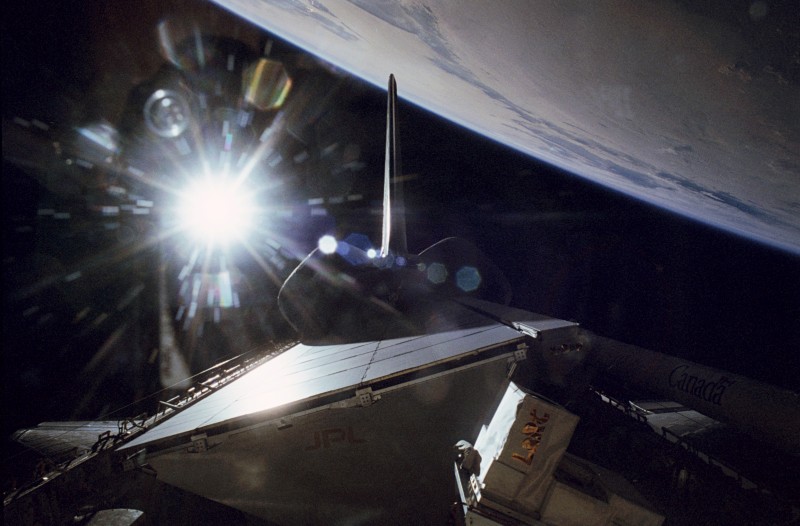
Today, the Sun crosses the celestial equator heading south at 0951 UT. Known as the equinox, the astronomical event marks the first day of autumn in the northern hemisphere and spring in the south. Equinox means equal night and with the Sun on the celestial equator, Earth dwellers will experience nearly 12 hours of daylight and 12 hours of darkness. Of course, for those in the south, the days will grow longer with the Sun marching higher in the sky as summer approaches. A few weeks after the September Equinox of 1994, the Crew of the shuttle orbiter Endeavour recorded this image of the Sun poised above the Earth's limb. Glare illuminates Endeavour's vertical tail (pointing toward the Earth) along with radar equipment in the payload bay.