The Sun
The Sun is a yellow dwarf star (G2V), about 4.6 billion years old, and the dominant gravitational force in the Solar System. It has a diameter of roughly 1.4 million kilometers and contains around 99.8% of the Solar System’s mass. Nuclear fusion in its core converts hydrogen into helium, producing energy that warms the planets. Above the core lie the radiative and convective zones, followed by the visible photosphere (~5,500 °C), the chromosphere, and the much hotter corona (~2 million °C).
Source: science.nasa.gov
APODs including "The Sun"
The Great Carina Nebula
27/10/2007
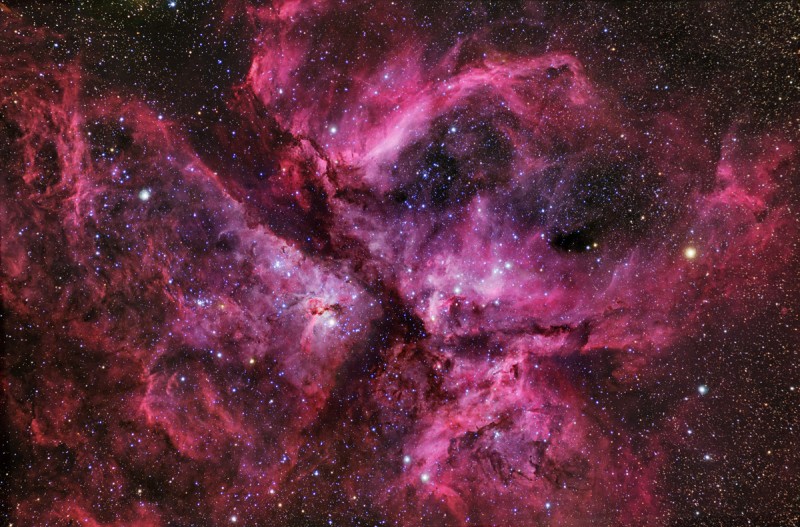
A jewel of the southern sky, the Great Carina Nebula, aka NGC 3372, spans over 300 light-years, one of our galaxy's largest star forming regions. Like the smaller, more northerly Orion Nebula, the Carina Nebula is easily visible to the naked eye, though at a distance of 7,500 light-years it is some 5 times farther away. This stunning telescopic view reveals remarkable details of the region's glowing filaments of interstellar gas and dark cosmic dust clouds. The Carina Nebula is home to young, extremely massive stars, including the still enigmatic variable Eta Carinae, a star with well over 100 times the mass of the Sun. Eta Carinae is the bright star left of the central dark notch in this field and just below the dusty Keyhole Nebula (NGC 3324).