The Sun
The Sun is a yellow dwarf star (G2V), about 4.6 billion years old, and the dominant gravitational force in the Solar System. It has a diameter of roughly 1.4 million kilometers and contains around 99.8% of the Solar System’s mass. Nuclear fusion in its core converts hydrogen into helium, producing energy that warms the planets. Above the core lie the radiative and convective zones, followed by the visible photosphere (~5,500 °C), the chromosphere, and the much hotter corona (~2 million °C).
Source: science.nasa.gov
APODs including "The Sun"
A Tale of Comet Holmes
10/11/2007
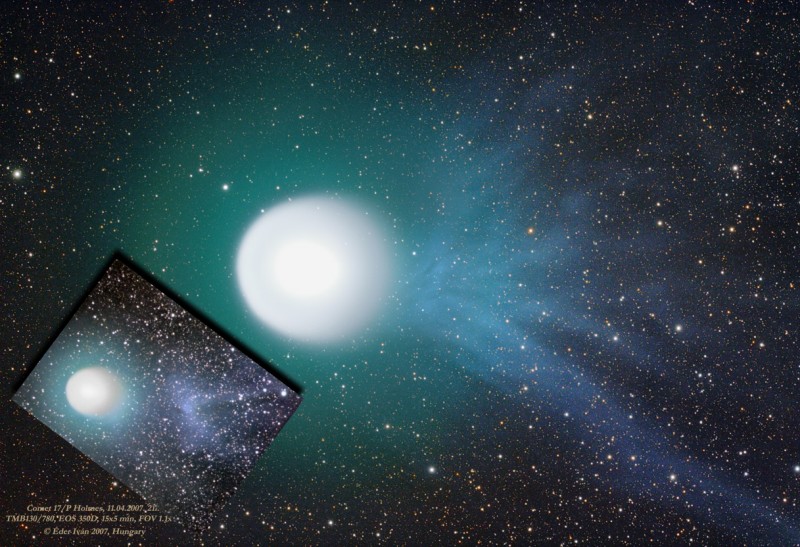
A beautiful blue ion tail has become visible in deep telescopic images of Comet Holmes. Pointing generally away from the Sun and also planet Earth, the comet's ion tail is seriously foreshortened by our extreme viewing angle. Still, enthusiastic comet watchers have remarked that on the whole, the compact but tentacled appearance suggests a jellyfish or even a cosmic calamari. This stunning view of the comet's greenish coma and blue tail was recorded on November 4 in clear skies near Budapest, Hungary. The colors are caused by molecules in the tenuous gas, like C2 (green) and CO+ (blue), fluorescing in sunlight. In a more recent development, the dramatic inset is a deep image from L'Aquila in central Italy on November 8, showing the ion tail disconnecting from the comet.