The Sun
The Sun is a yellow dwarf star (G2V), about 4.6 billion years old, and the dominant gravitational force in the Solar System. It has a diameter of roughly 1.4 million kilometers and contains around 99.8% of the Solar System’s mass. Nuclear fusion in its core converts hydrogen into helium, producing energy that warms the planets. Above the core lie the radiative and convective zones, followed by the visible photosphere (~5,500 °C), the chromosphere, and the much hotter corona (~2 million °C).
Source: science.nasa.gov
APODs including "The Sun"
Forest and Sky
17/11/2007
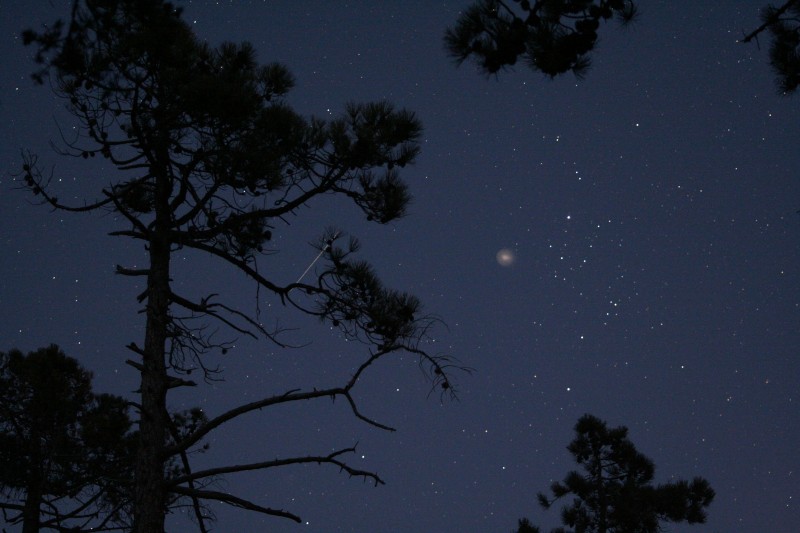
With pine trees in dim silhouette, this skyscape from Breil-sur-Roya in southern France was captured on November 11. In the early evening scene, a satellite seems to streak through the branches, while bright, round, fuzzy Comet Holmes appears to lie just beyond them, near the stars of the constellation Perseus. Mirfak, alpha star of Perseus, is the brightest star above the comet and to the right. Next Monday (November 19), Holmes will be close enough to Mirfak to view the star through the remarkable comet's expanding coma. Recent measurements place the dusty coma's diameter at about 1.4 million kilometers, even larger than the Sun. Ed.'s Note: Predawn skies this weekend will feature the Leonids Meteor Shower.