The Sun
The Sun is a yellow dwarf star (G2V), about 4.6 billion years old, and the dominant gravitational force in the Solar System. It has a diameter of roughly 1.4 million kilometers and contains around 99.8% of the Solar System’s mass. Nuclear fusion in its core converts hydrogen into helium, producing energy that warms the planets. Above the core lie the radiative and convective zones, followed by the visible photosphere (~5,500 °C), the chromosphere, and the much hotter corona (~2 million °C).
Source: science.nasa.gov
APODs including "The Sun"
An Avalanche on Mars
11/03/2008
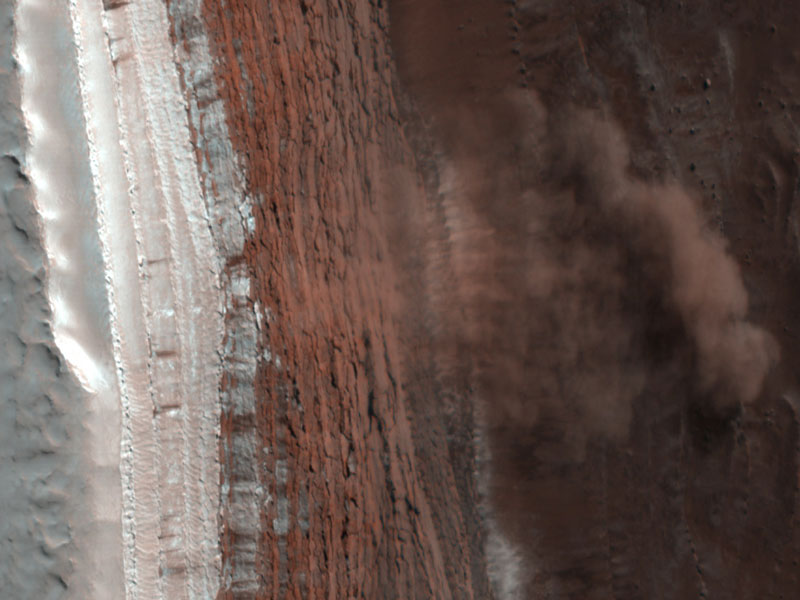
What caused this sudden cloud of dust on Mars? An avalanche! The first avalanche imaged in progress on another planet was recorded last month on Mars by NASA's robotic Mars Reconnaissance Orbiter. Visible in the above picture, digitally rescaled, are several layers of white ice thawing over red rock, with darker colors toward the right indicated Martian soil that mixed with lesser amounts of ice. As the cliff of over 700 meters high was thawing, falling ice crashed down raising plumes of ice and dust so thick they cast visible shadows. The scarp has slopes with grades greater than 60 degrees. The entire scene is illuminated from the upper right by the Sun. A thaw occurs each spring in the Northern Hemisphere of Mars, as the warming climate causes solid carbon dioxide ice to sublimate directly to vapor. Studying such avalanches allows planetary geologists to better understand soil configurations on Mars.