The Sun
The Sun is a yellow dwarf star (G2V), about 4.6 billion years old, and the dominant gravitational force in the Solar System. It has a diameter of roughly 1.4 million kilometers and contains around 99.8% of the Solar System’s mass. Nuclear fusion in its core converts hydrogen into helium, producing energy that warms the planets. Above the core lie the radiative and convective zones, followed by the visible photosphere (~5,500 °C), the chromosphere, and the much hotter corona (~2 million °C).
Source: science.nasa.gov
APODs including "The Sun"
Moon over Byzantium
15/03/2008
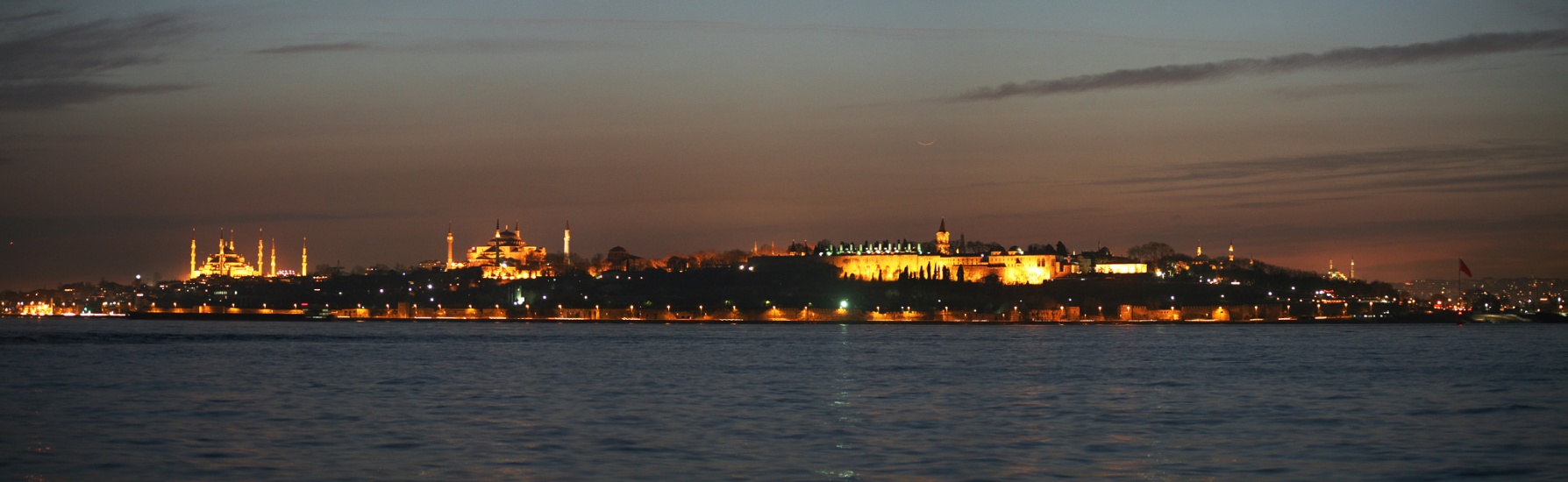
Hiding near the Sun, a slender crescent Moon is a difficult but rewarding sight. Look to the right (scroll right) and you can spot one in this twilight panorama across the Bosporus Strait and along the skyline of the historic city of Istanbul. Recorded on March 8, the Moon is a mere 22 hours young. A thin, curved edge of the Moon's illuminated surface is just visible poised in the western sky at sunset above the walls of Topkapi Palace. The palace was built in the reign of Ottoman Sultan Mehmed II, the 15th century conquerer of the city that was then Constantinople, capital of the Byzantine Empire. The well-lit domed building immediately to the left of the palace is Ayasofya (Hagia Sophia), a famous example of Byzantine architecture, now a museum. Still farther to the left is the Sultan Ahmed Mosque